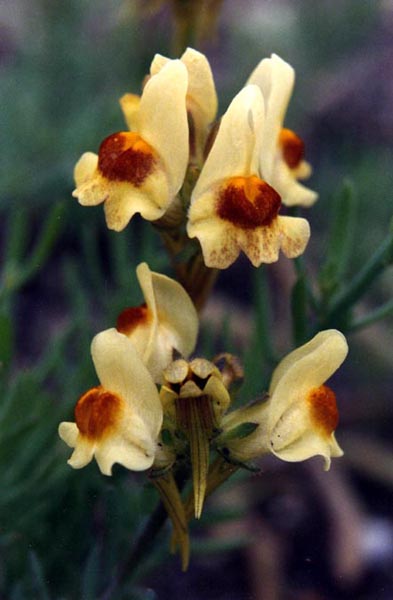
Perennial of the Plantaginaceae family, Linaria tristis is an Iberian species, mainly found in the south and center of Spain, as well as in Portugal and Morocco. It colonizes rocks, scree, and old walls, on dry, well-drained substrates, often calcareous or schistose, between 500 and 2,000 meters altitude.
It forms small low and compact clumps, rarely beyond 20 cm, with fine and linear foliage, glaucous-green, dense and persistent. The flowers, typical of toadflaxes, are bicolored and here personalized by a corolla of warm cream yellow, highlighted by a deep mahogany-brown palate, almost circular and very clearly defined. The spur, of the same cream hue as the corolla, is well developed. The color variability between populations is notable: the background can turn to a more pronounced sulfur yellow, while the palate can tend towards purplish-brown or almost blackish brown.
In its natural habitat, its flowering extends from May to July. In cultivation, it can bloom as early as April in well-exposed situations.
It requires very draining, poor soil, in full sun, and withstands summer drought well. An excellent candidate for dry rock gardens and walls.