Perennial of the Plantaginaceae family, native to the Iberian Peninsula and northwest Portugal in particular, where it grows in grassy fringes, forest edges, shaded banks, and roadsides, at modest altitudes, in generally cool and semi-shaded environments.
It forms bushy, upright clumps, reaching 60 to 100 cm in height, with sturdy stems bearing medium green, oval-lanceolate leaves arranged in whorls of three or four. It is one of the most imposing toadflaxes cultivated in gardens.
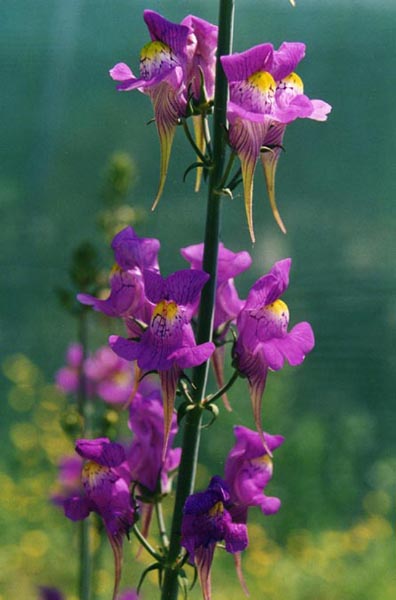
The flowers are exceptionally large for the genus: widely open, pink-lilac to bright pink-purple, with a bright yellow palate streaked with purple and a long, curved spur. They are borne in groups of three along the stems, hence the species name — triornithophora meaning "bearing three birds" — as each group indeed evokes a small suspended flock. Up close, the flower reveals a complexity and chromatic richness akin to certain orchids.
In its natural habitat, its flowering extends from June to August. In cultivation, it can bloom from May to September under favorable conditions.
It accepts ordinary soil, fresh to well-drained, in sun or partial shade, and readily self-seeds. Hardy to about -10°C, it deserves a place in natural beds, the edges of wooded gardens, or large generous rockeries.