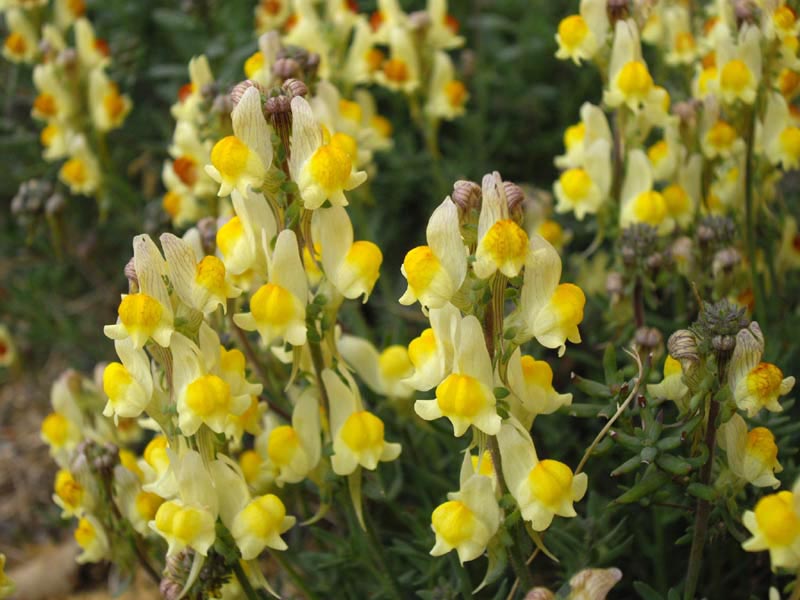
Short-lived perennial of the Plantaginaceae family, native to southwestern Europe, mainly the Iberian Peninsula and southern France. It colonizes sands, gravels, calcareous or siliceous screes, and disturbed open grounds, from the plains to the subalpine level.
It forms dense tufts, with numerous, slender, ascending stems, 8 to 15 cm in height, giving it both a compact habit and an airy lightness. The foliage is fine, linear, glaucous green, arranged in tight whorls along the slender stems. The flowers are pale yellow to cream yellow, with the palate of the lower lip a bright yellow to intense orange, well contrasted; this discreet yet precise bicolor is one of the most characteristic traits of the species. The floral mass, very abundant at full bloom, retains something ethereal despite its density.
In its natural habitat, its flowering extends from May to August depending on altitude. In cultivation, it can bloom as early as April in well-exposed situations, and a light mowing after the first flowering can stimulate a resurgence.
It requires full sun and a very well-drained, sandy or gravelly, poor and dry soil; it does not tolerate heavy soils or stagnant winter moisture. Its density and floral generosity make it a remarkable subject for large rock gardens, gravel gardens, and sunny embankments.