A perennial of the Linaceae family, Linum perenne is widely spread in Central and Eastern Europe, from the Iberian Peninsula to Western Siberia, passing through the Alps, the Balkans, and the steppes of Central Asia. It occupies dry grasslands, sunny calcareous hillsides, edges of poor meadows, and rocky slopes, from the plains to the montane level.
It forms a bushy clump with fine, upright stems that are slightly arched at the top, reaching 30 to 60 cm in height. The foliage is narrow, linear, a glaucous green to gray-green, very dense on the stems, giving it a visual lightness that contrasts with the abundance of flowering. Garden photos well illustrate this blue cloud effect that a well-established clump in full bloom can produce.
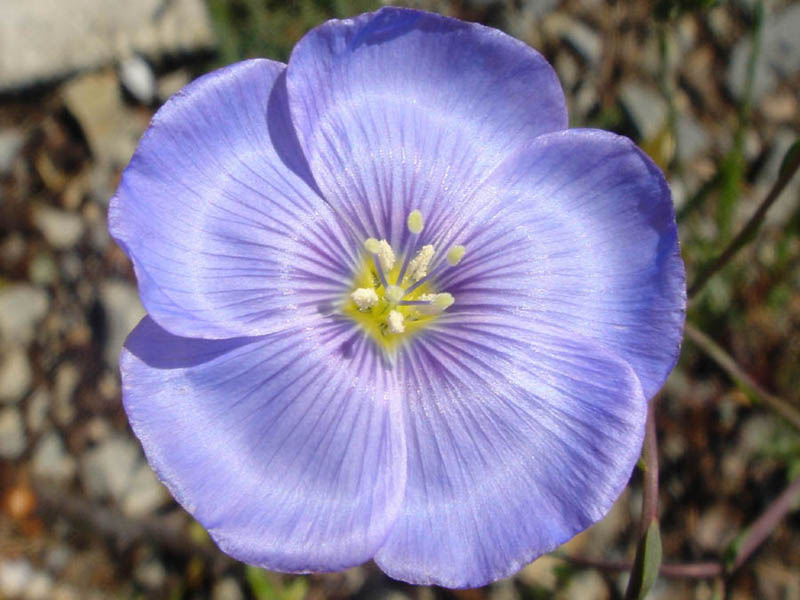
The flowers, a delicate sky-blue to lavender-blue, with five broad and silky petals, are traversed by fine darker veins radiating from a pale yellow center. Each flower is ephemeral, lasting only one day, but their uninterrupted succession ensures a remarkable continuous effect. In its natural habitat, it blooms from May to July. In cultivation, it can start as early as April and extend until August depending on exposure.
It thrives in full sun, in well-drained soil, preferably calcareous, poor to moderately rich. Perfectly hardy and tolerant of summer drought, it readily reseeds itself and benefits from being rejuvenated regularly, as aging clumps tend to become sparse at the base.