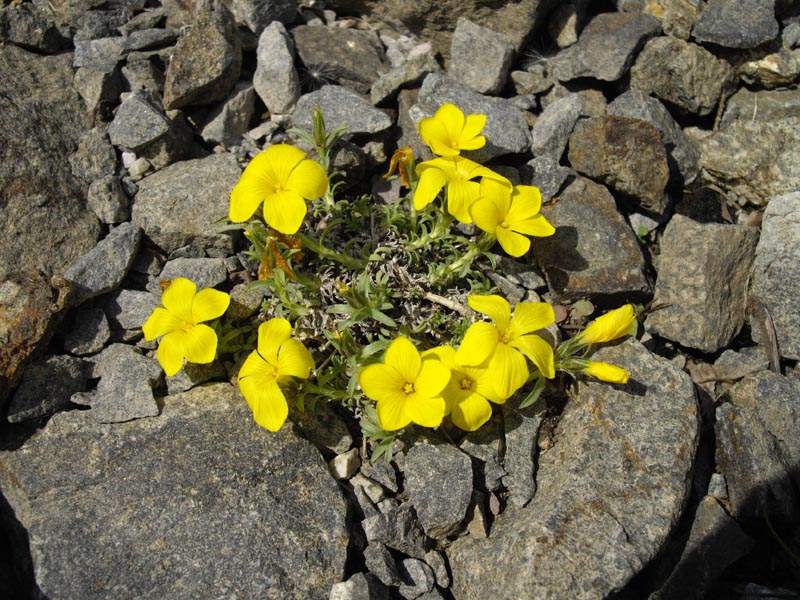
A perennial of the Linaceae family, Linum cariense originates from western Anatolia, in the historical region of Caria, Turkey, from which it derives its name. It colonizes rocky screes, stony slopes, and crevices between boulders, at high altitudes, in conditions of strong sunlight and extreme drainage.
The photos show a remarkably compact plant, almost lying between the stones, forming a very dense and woody small tuft at the base, barely a few centimeters high. The short stems bear narrow, linear, slightly pubescent foliage, of a grayish-green, with persistent dry leaf remnants at the base giving the stock a characteristic woolly and bushy appearance.
The flowers are large relative to the size of the plant, with five intense and bright yellow petals, well spread, distinctly veined, borne on short erect stems that emerge directly from the tuft. Their proportion to the foliage is striking. In its natural habitat, flowering extends from June to July depending on altitude.
In cultivation, it requires perfect drainage, a poor mineral substrate, and full sun exposure; it does not tolerate stagnant winter moisture. Its natural place is the alpine rock garden or the cold greenhouse.