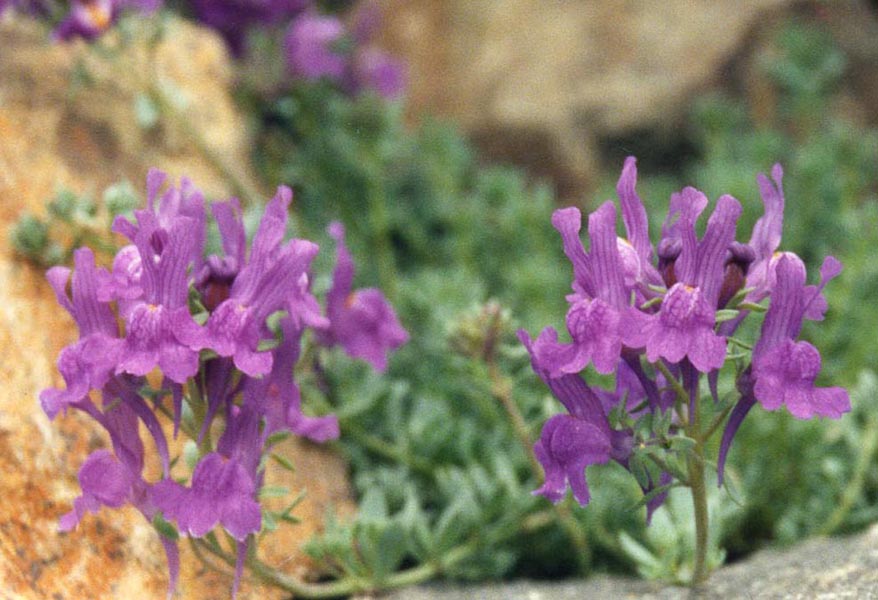
Short-lived perennial, perpetuating mainly by spontaneous reseeding, from the Plantaginaceae family, present in the Alps, the Pyrenees, the Apennines, and the Carpathians. It colonizes mobile scree, moraines, glacial gravel, and open rockeries, generally between 1,800 and 3,500 meters, on calcareous or siliceous substrates indifferently.
The plant forms small spreading tufts, rarely beyond 10 cm in height, with prostrate to ascending stems bearing linear, fleshy, glaucous leaves arranged in whorls. The flowers, grouped in dense terminal clusters, are a bright violet-purple to bright lilac, with a contrasting bright orange palate — this color combination is one of the most striking spectacles of the alpine flora. The spur is thin and elongated.
In its natural habitat, its flowering extends from July to September depending on the altitude. In cultivation, it can bloom as early as June.
Pioneer species of disturbed high-altitude terrains, it reseeds easily and can move from one season to another in the rockery. It requires full sun, a very well-drained, gravelly, rather poor soil, and does not tolerate winter stagnation well. Ideal slipped between the stones of a well-exposed rockery.