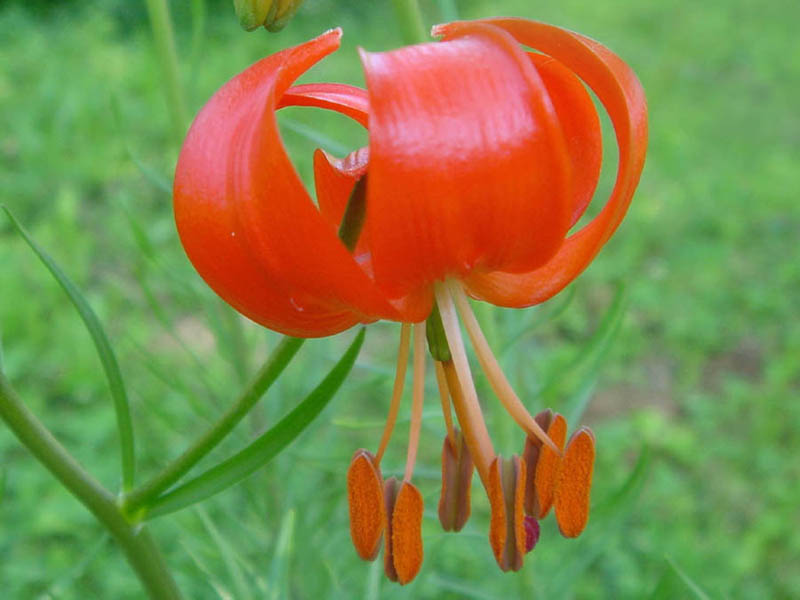
Bulbous perennial of the Liliaceae family, native to East Asia — Northern China, Mongolia, Southern Siberia, Korea, and Manchuria — where it grows in grassy steppes, dry slopes, and open meadows, often on light and well-drained soils.
It is one of the most graceful lilies of the genus: the thin and flexible stems reach 30 to 60 cm, bearing very narrow, almost grass-like foliage, scattered along the stem. The turban-shaped flowers, with strongly reflexed tepals, are a bright red-orange, without spots or with a few discreet dots at the base, which clearly distinguishes them from tiger lilies. The prominent stamens bear large orange anthers. Each stem can carry about ten flowers, arranged in a light and airy cluster that sways with the slightest breeze.
In its natural habitat, it blooms from June to July. In cultivation, it occurs at the same times, often among the first lilies of the season.
It is grown in full sun, in well-drained, light, dry to fresh soil, neutral to slightly calcareous. It withstands harsh winters but dreads stagnant moisture in winter. A short-lived species, it reseeds easily and willingly perpetuates itself in rock gardens and light flower beds.