Bulbous perennial of the Liliaceae family, this variety is native to western China, mainly Sichuan and Yunnan, where it grows in alpine meadows, forest edges, and grassy slopes, between approximately 2,000 and 3,500 meters.
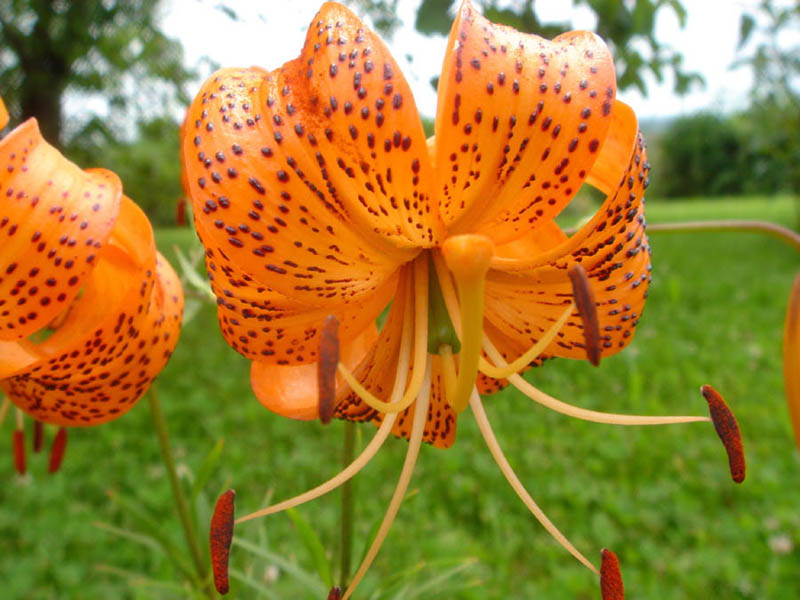
The stems are slender, robust, reaching 90 to 120 cm, densely leafed with narrow, linear leaves arranged in tight whorls. Each stem bears a large number of turban-shaped flowers, with tepals strongly reflexed backward, in bright orange to burnt orange, densely speckled with dark purple to black-brown spots and blotches. The stamens are very prominent, with characteristic reddish-brown anthers. The abundance of flowering, sometimes with twenty flowers per stem, is one of the most striking features of this variety.
In its natural habitat, its flowering extends from July to August. In cultivation, it blooms at the same dates.
It is cultivated in full sun to light partial shade, in well-drained soil, cool in depth, slightly acidic to neutral. Like most Asian lilies, it appreciates having its roots in the shade and its head in the sun. Robust and vigorous, it readily naturalizes in flower-filled meadows and edges.