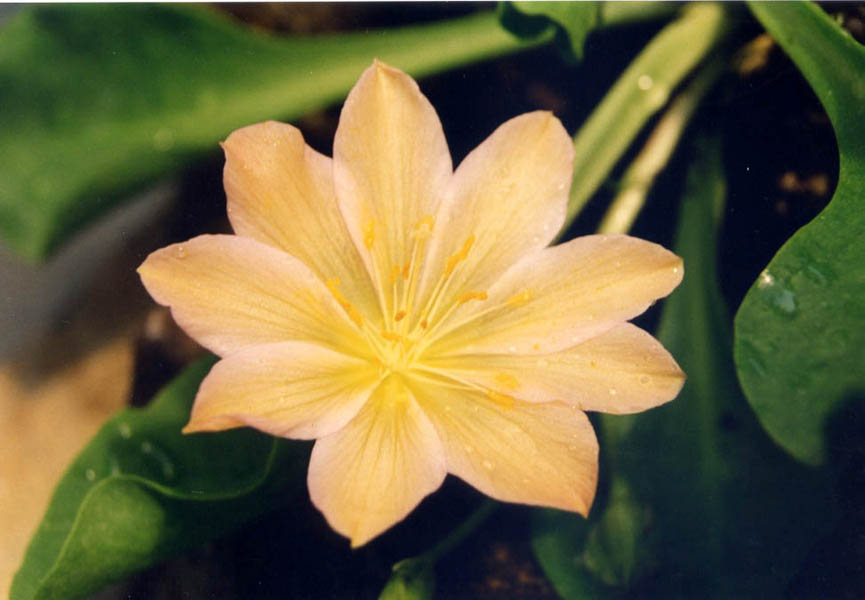
A perennial of the Montiaceae family, Lewisia tweedyi is endemic to a very restricted area straddling the north of Washington State and the south of British Columbia, in the foothills of the Cascades and the Wenatchee Mountains. It grows there on well-drained rocky slopes, in open coniferous woodlands or on granite ledges, between 800 and 1,800 meters, in a context of abundant winter snow and pronounced summer drought.
It is the largest and most spectacular of the lewisias: the rosette, large and spreading, is formed of oval to spatulate, fleshy, bright green leaves, which can reach 15 cm in length. The flowers, borne on short branched stems, are remarkably large for the genus, with eight to ten broad, silky petals, of a pale apricot to creamy salmon, subtly veined, with a center adorned with yellow stamens. The buds, orange before opening, accentuate the chromatic contrast.
In its natural habitat, its flowering extends from April to June depending on the altitude.
In cultivation, it is a plant reputed to be difficult to maintain long-term, even in a pot. In climates with wet winters, the unheated alpine greenhouse, with careful ventilation and a very well-drained slightly acidic substrate, offers the best chances of success, without guaranteeing the plant's longevity. Moisture at the collar, in winter as well as in the heart of summer, remains the main cause of loss. It is a species for patient and persistent collectors, whose exceptional flower justifies all efforts.