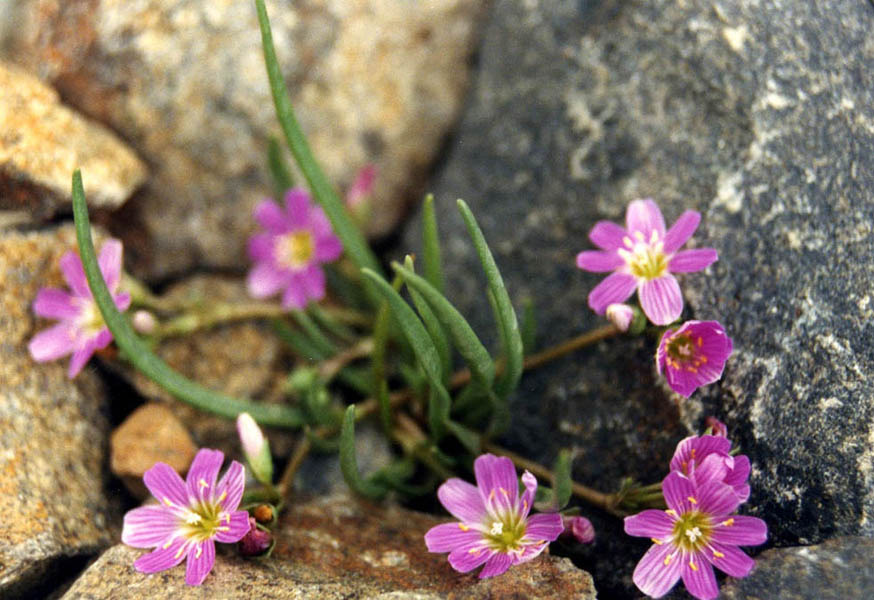
Perennial from the Montiaceae family, Lewisia pygmaea is one of the most widespread species of the genus at high altitudes, found from the western mountains of the United States to Canada and northern Mexico, in the Rockies, Sierra Nevada, and coastal ranges. It colonizes snow beds, moist alpine meadows in season, and fine scree, generally between 2,000 and 4,000 meters, where snowmelt provides temporary moisture before a marked summer drought.
It is a tiny plant, barely exceeding 5 to 8 cm in height, forming a small loose rosette of linear, narrow, and elongated leaves, of medium green, flexible and not fleshy, which distinctly sets it apart from other lewisias with succulent foliage.
The flowers, borne on thin, slender, and spreading stems, are small, with five to nine pink to magenta pink petals, distinctly veined with deeper pink, with a pale yellow center and yellow stamens. In its natural habitat, its flowering extends from June to August depending on altitude and snow cover.
In cultivation, it is delicate and rarely offered in common commerce; it is suitable for the alpine box or high mountain garden recreating its natural conditions, with spring moisture and summer drought respected.