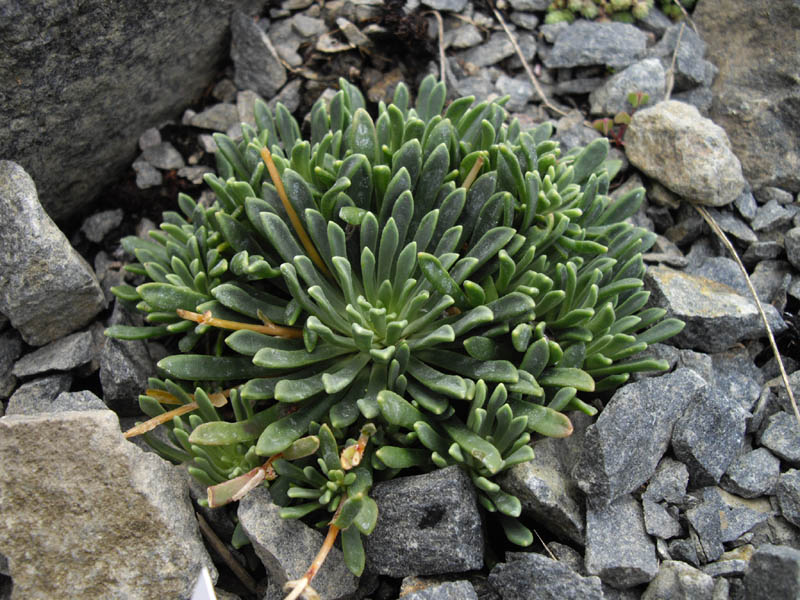
Perennial of the Montiaceae family, Lewisia columbiana is native to the mountains of western North America, from British Columbia to Oregon and Idaho. It occupies rocky cliffs, stabilized scree, and stony ledges at altitude, generally between 1,000 and 2,500 meters, on well-drained, acidic to neutral substrates.
It forms a compact and persistent rosette of linear, fleshy, dark green and glossy leaves, tight and short, with the whole not exceeding 4 to 5 cm in height outside of flowering. From this dense tuft rise slender, reddish stems, branched into light panicles, reaching 8 to 10 cm.
In its natural habitat, its flowering extends from June to August. The 'Alba' cultivar bears pure white to very pale pinkish-white flowers, with narrow petals slightly veined with pink, gathered in airy bouquets that seem to float above the foliage. In cultivation, flowering generally occurs from May to July and can continue in successive waves.
Like all lewisias, it dreads stagnant moisture at the collar in winter. Planting between two rocks in a slightly inclined position, or in a pot with rigorous drainage, remains the best approach. It prefers a semi-shaded exposure under our latitudes, in a mineral substrate enriched with humus.