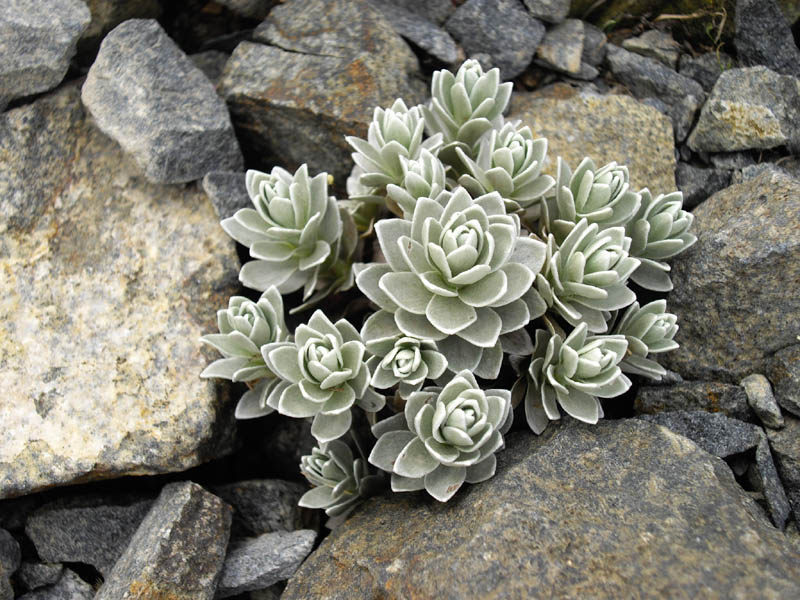
A perennial of the Asteraceae family, Leucogenes leontopodium is endemic to the North Island of New Zealand, where it grows in screes, rocky areas, and windy high-altitude ridges, generally between 1,200 and 1,800 meters. It favors well-drained mineral substrates, often on acidic to volcanic rocks, exposed to the elements.
It forms dense, tight, low, and compact cushions, composed of numerous interlocking rosettes covered with a dense silvery tomentum that gives them an almost sculptural appearance. The leaves, small, spatulate, and very woolly, are arranged in regular spirals reminiscent of sempervivum rosettes from afar, but in a bright silvery gray and soft to the touch.
In its natural habitat, its flowering extends from December to February (southern summer). The inflorescences, small and whitish, surrounded by starry woolly bracts in the manner of Leontopodium, remain discreet compared to the permanent ornamentation of the foliage.
What strikes one most about this plant is the geometric perfection of its silvery rosettes, visible all year round. In cultivation under our latitudes, it requires perfect drainage, very limited winter humidity, and a sunny exposure. It is preferably grown in a pot or trough, sheltered from excessive winter rains.