(Leuzea conifera)
(Leuzea conifera)
Pinecone Leuzea, Pinecone of the garrigues. Perennial of the Asteraceae family, Leuzea conifera is widespread in the western Mediterranean basin, from the Iberian Peninsula to the Maghreb and up to Southern France. It colonizes dry grasslands, open garrigues, the edges of oak forests, and sunny calcareous slopes, from sea level up to about 1,500 meters in altitude.
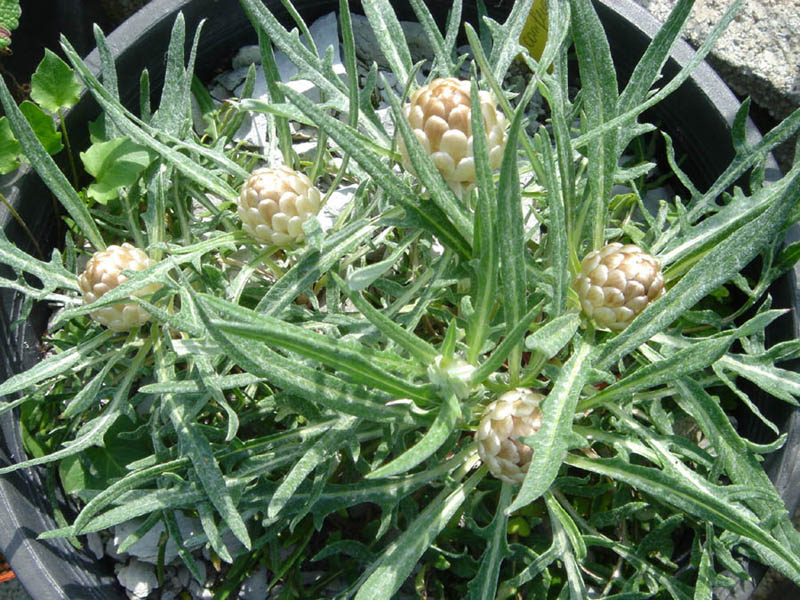
It forms a basal rosette of lanceolate leaves, cut into pinnatilobed shapes, grayish-green on top and whitish and tomentose underneath, from which erect stems rise 15 to 30 cm, each bearing a solitary flower head. This flower head is the most striking element of the plant: an ovoid to globular involucre, composed of imbricated scarious bracts, golden to light brown and shiny, which imitates with a disturbing precision a small pine cone. It is this unique characteristic in the Mediterranean flora that has earned it all its vernacular names.
In its natural habitat, its flowering extends from May to July. The tubular flowers, lilac pink to bright pink, emerge in a light crown from the top of this leathery involucre, delicately contrasting with the matte gold of the bracts. At the end of the season, the dry head transforms into an ornamental feathery structure, where the silky pappus of the achenes forms an airy white tuft.
In cultivation, it requires full sun, a calcareous or neutral soil, perfectly drained and rather poor. Hardy and undemanding once established, it withstands summer drought well and readily reseeds in warm rock gardens. Its dry flower heads persist long on the plant and retain their appeal well beyond flowering.