Perennial of the Asteraceae family, Leucanthemum atratum is a species of the Eastern Alps and the Carpathians, found from Austria to Slovenia and northern Italy. It occupies scree, rocky areas and windy ridges on siliceous or mixed substrates, between 1,800 and 2,800 meters in altitude.
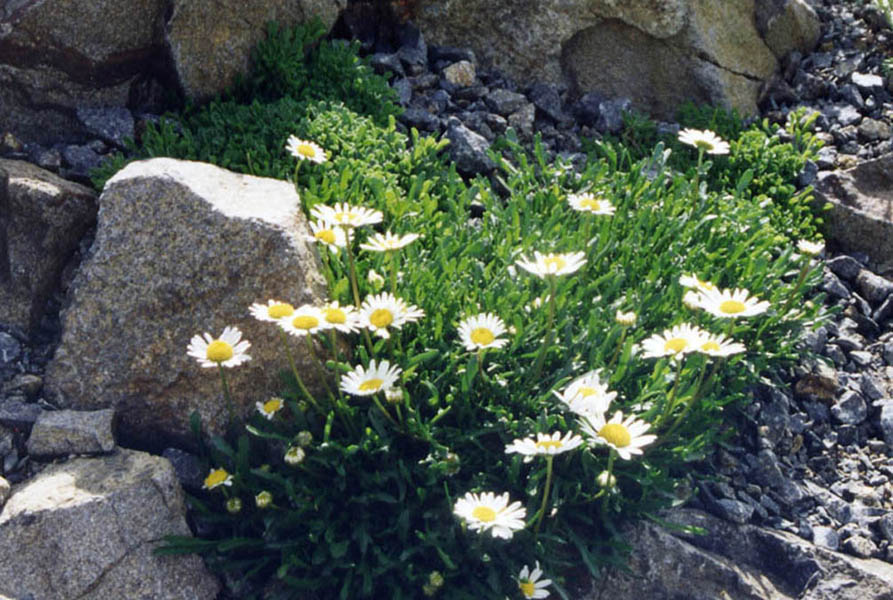
As shown in the photograph, it forms low, dense clumps, widely spread between the boulders, barely ten centimeters in height excluding flowers. The foliage is bright green, compact, with spatulate and notched leaves. The short flowering stems each bear a single capitulum with pure white ligules arranged around a well-rounded bright yellow central disc, in the style of large daisies but in a much smaller and stockier format.
In its natural habitat, its flowering extends from July to August depending on exposure and altitude. In cultivation, it blooms in June-July.
In rock gardens, it requires a very well-drained, mineral, poor soil, in full exposure. It tolerates winter cold well provided stagnant moisture is avoided. Its ability to settle between the boulders and cover the rocky substrate makes it a species particularly suited to authentic alpine gardens.