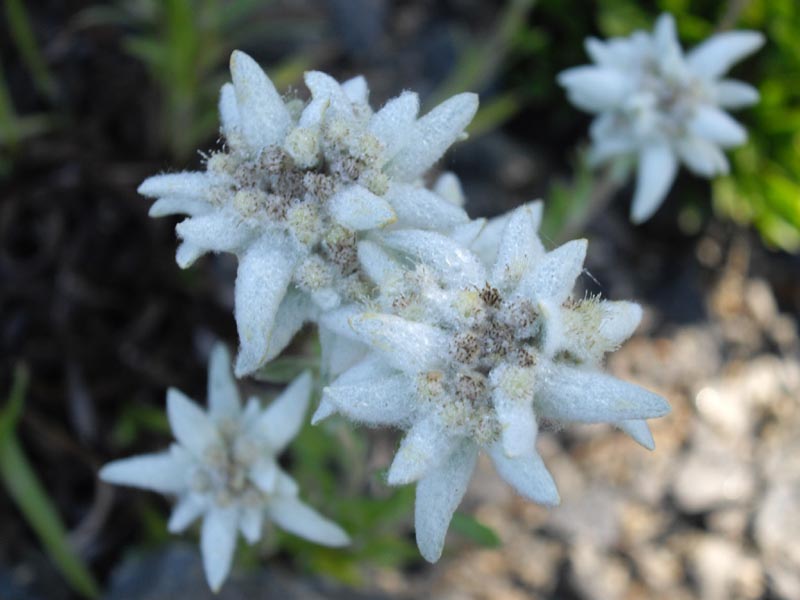
The comparison between commercially sourced plants and wild-origin stocks reveals a striking difference: in the latter, the inflorescence is much more compact, with short and tight bracts forming a gathered star, almost spherical at its center, very different from the widely spread star presented by ordinary cultivated forms. The dense, cottony white tomentum uniformly covers bracts and leaves, further accentuating this tight and woolly appearance. The central capitula, multiple, are barely distinguishable from the rest of the inflorescence as the white wool is overwhelming.
In its natural habitat, its flowering extends from July to September. In cultivation, it usually occurs in June-July.
It requires a very well-drained, mineral soil, in full exposure. Sensitive to excess winter humidity under an Atlantic climate, it performs better under cold glass or in an alpine trough. Wild-collected stocks, true to their original morphology, represent a significant botanical interest for a demanding collection.