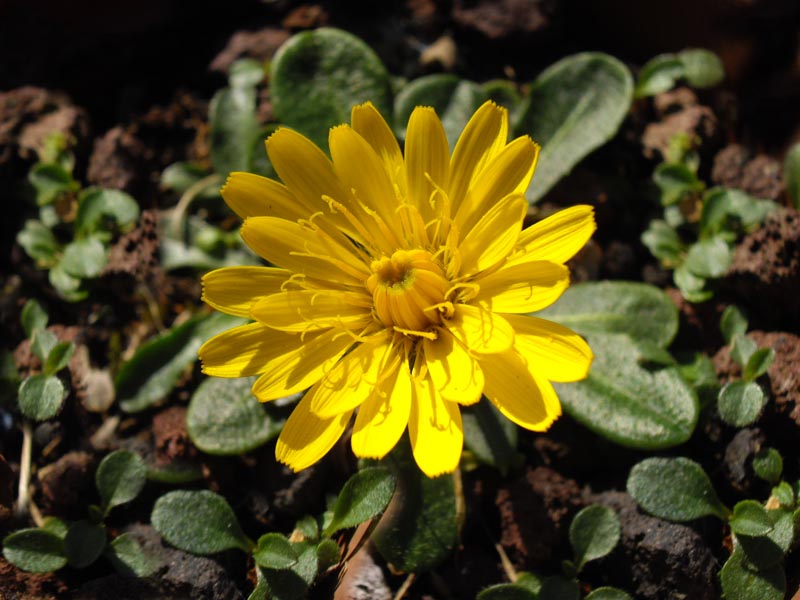
A perennial of the Asteraceae family, the Pyrenean Lion's Tooth is found in the Pyrenees, the Alps, and the Massif Central. It colonizes alpine and subalpine meadows, stabilized scree, rock crevices, and snow hollows, generally between 1,800 and 2,800 meters in altitude.
The plant forms a dense and flattened basal rosette, with oblong to spatulate leaves, entire to slightly sinuate, dark green and glossy, finely hispid. The short stems each bear a single bright yellow ligulate capitulum, which blooms almost at the level of the foliage. This very compressed habit, characteristic of high-altitude individuals, is maintained in cultivation in the lowlands, where the plant remains small and compact.
In its natural habitat, its flowering extends from July to September depending on the altitude. In cultivation, it can bloom as early as June.
It requires full sun, a poor, mineral, and well-drained soil. It withstands summer drought once established and is suitable for rock gardens, walls, and gravel gardens of alpine character.