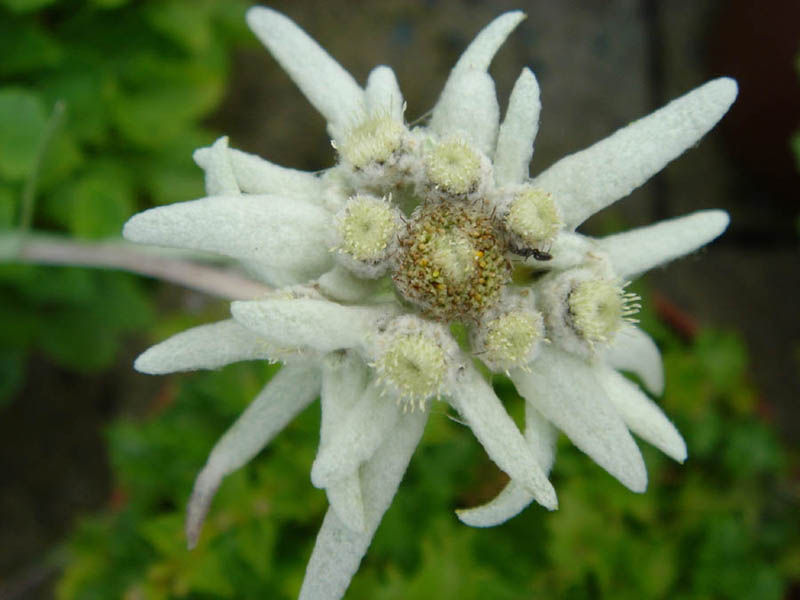
Perennial of the Asteraceae family, the Edelweiss is one of the most emblematic plants of the European mountains. Its natural range covers the Alps, the Pyrenees, the Carpathians, and other Eurasian massifs. It grows in rocky lawns, calcareous screes, and cliff ledges, generally between 1,700 and 3,000 meters altitude, often on a well-drained calcareous substrate exposed to the sun.
The plant forms loose clumps of erect stems, reaching 8 to 15 cm in height. The leaves, lanceolate, are entirely covered with a whitish-gray woolly tomentum that gives them a characteristic velvety appearance. This coating, present on all aerial parts, is an adaptation to intense ultraviolet radiation and desiccation at high altitudes.
What is commonly taken for a flower is actually a set of star-shaped bracts, densely tomentose, pure white to gray-white, arranged in rays around several small yellow-green tubular capitula grouped in the center. The natural variability of the species is real: the number of bracts, their width, and the intensity of the tomentum differ significantly from one population to another.
In its natural habitat, its flowering extends from July to September. In cultivation, it generally occurs from June to August.
Long picked as a sign of alpine bravery, the Edelweiss is now protected in most countries where it naturally grows. In cultivation, it requires full sun, a calcareous, poor, very well-drained soil, and suffers from any excess winter moisture. It thrives in dry rock gardens, wall crevices, or elevated containers.