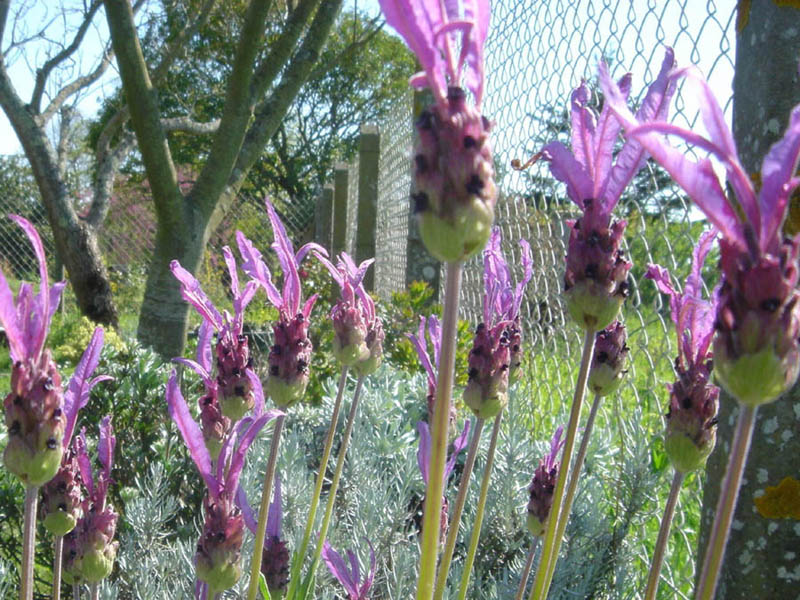
Lamiaceae. Perennial shrub native to the Mediterranean basin, from the Iberian Peninsula to the Turkish coasts, also present in the Canary Islands and North Africa. It colonizes scrublands, maquis, rocky siliceous slopes, and open pine forests, generally from sea level up to 800 meters, in full sun exposure.
It forms a compact and rounded bush 40 to 80 cm in height, with densely leafy gray-greenish branches. The leaves are narrow, linear, slightly tomentose, of a medium gray-green, very aromatic when crushed — with a camphor scent more powerful and less subtle than that of Lavandula angustifolia.
The floral silhouette is immediately recognizable: the short and squat spikes, from dark purple to deep violet, are crowned with large erect sterile bracts, pink-violet to bright purple, evoking rabbit ears — hence its English nickname of French lavender or butterfly lavender. It is this banner of bracts, persisting well after the flowers have fallen, that constitutes its most singular sign among all lavenders.
In its natural habitat, its flowering extends from April to June. In cultivation under mild climates, it can bloom again in autumn after a light pruning. It requires poor, very well-drained soil, calcareous or siliceous, in full sun. Its hardiness is limited, around -8 to -10°C, and it dreads both winter humidity and prolonged frost.