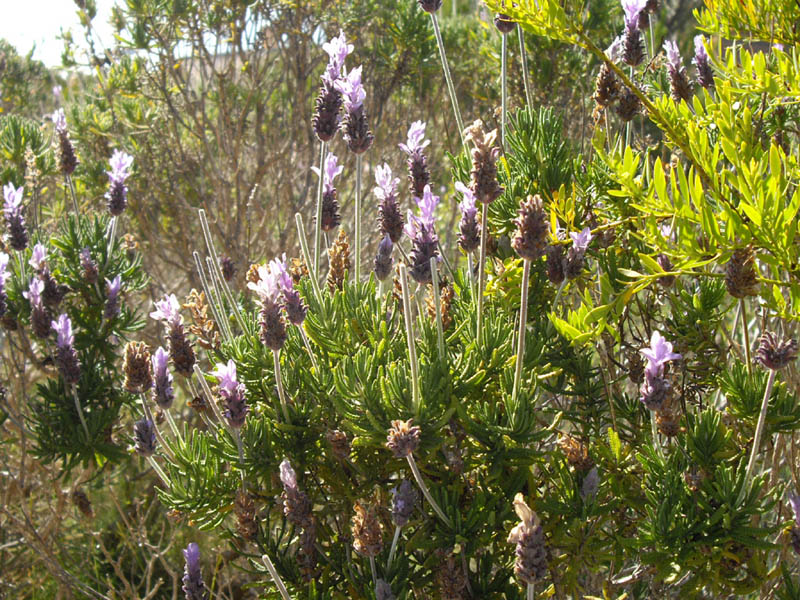
photographed in Spain
photographed in Spain
Lamiaceae. Perennial shrub native to the western Mediterranean basin, the Iberian Peninsula, and North Africa, also found in the Canary Islands and the Middle East. It grows on rocky slopes, open garrigues, and well-drained calcareous soils, in full light, from sea level up to about 800 meters.
It forms a dense, rounded shrub 60 to 90 cm in height, with woody stems at the base and gray-whitish branches. The leaves are narrow, elongated, silver-green gray, and have regular and characteristic teeth on their margins, which give it its epithet and immediately distinguish it from other lavenders by touch as well as sight.
The floral spikes, standing on long slender stalks, are topped with very ornamental violet sterile bracts that persist after the flowers fall. The flowers themselves are a medium blue-violet. In its natural habitat, its flowering extends almost all year in mild regions, with a peak in spring and autumn. In cultivation under temperate climates, it blooms mainly from May to July.
Less hardy than Lavandula angustifolia, it poorly tolerates prolonged frosts below -5 to -8°C and requires a very well-drained, poor, and sunny soil. It is perfectly suited to Mediterranean dry gardens, rock gardens, and pots in regions with mild winters.