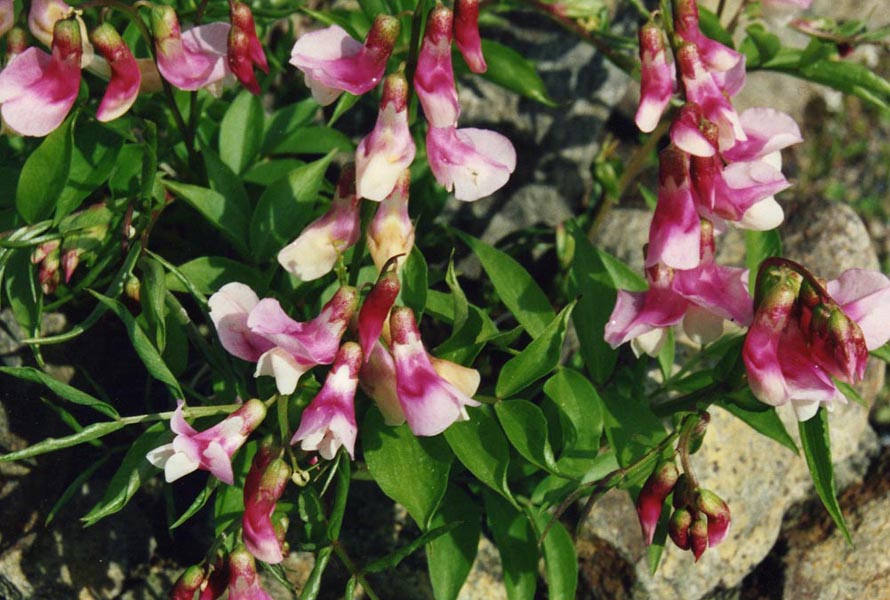
Fabaceae. A perennial native to Europe and temperate Asia, widely spread from lowland deciduous forests to mountain edges, up to about 1,500 meters. It grows in open woodlands, thickets, and shaded edges on fresh, humus-rich soils, often alongside spring geophytes.
It forms upright, non-climbing clumps, unlike most vetches, reaching 20 to 40 cm in height. The leaves consist of two to four pairs of oval-lanceolate leaflets, a bright and shiny green, without tendrils — replaced by a terminal point. This bushy and self-supporting habit, without clinging or support, is one of its distinctive traits in the genus.
The papilionaceous flowers, borne in lateral clusters of four to eight flowers, exhibit a remarkable color change throughout their development: the buds are dark reddish-purple, then the flower opens in bright bicolored pink, gradually turning to blue-violet and then pale pink as they age. Several shades thus coexist simultaneously on the same cluster. In its natural habitat, its flowering extends from April to June. In cultivation, it blooms from March-April.
It is easily cultivated in fresh, well-drained, humus-rich soil, in partial shade or under deciduous trees. It disappears completely in summer after fruiting. Hardy and long-lived, it reseeds moderately.