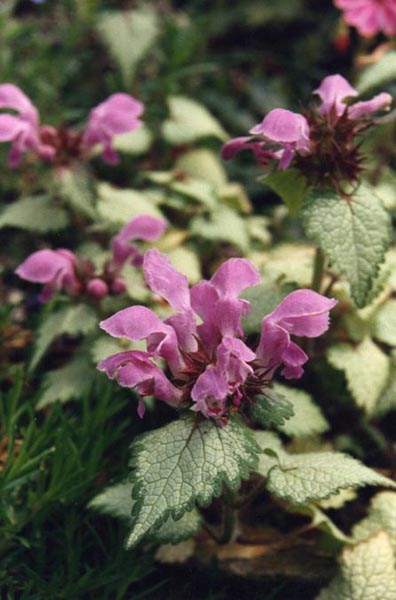
A stoloniferous perennial of the Lamiaceae family, the spotted dead-nettle is native to Europe and Western Asia, where it colonizes cool woodlands, shaded edges, and moist banks, on humus-rich soils.
The 'Beacon Silver' cultivar forms a dense, spreading carpet, with flowering stems not exceeding 15 to 20 cm. Its foliage is its main originality: the oval, crenate leaves are almost entirely covered in silver, retaining only a thin green border, which makes them particularly luminous under the canopy.
The bilabiate flowers, in a deep mauve-pink, are grouped in axillary whorls along the upright stems. In its natural habitat, the species blooms from April to June; in cultivation, this cultivar may sporadically rebloom in autumn.
Unlike Lamiastrum galeobdolon, whose flowers are entirely yellow, the spotted dead-nettle bears a lower lip spotted with white or paler pink, visible upon close examination of the flowers.
It requires a cool, humus-rich soil, in shade or partial shade, and does not tolerate prolonged drought well. An excellent ground cover for woodland compositions.