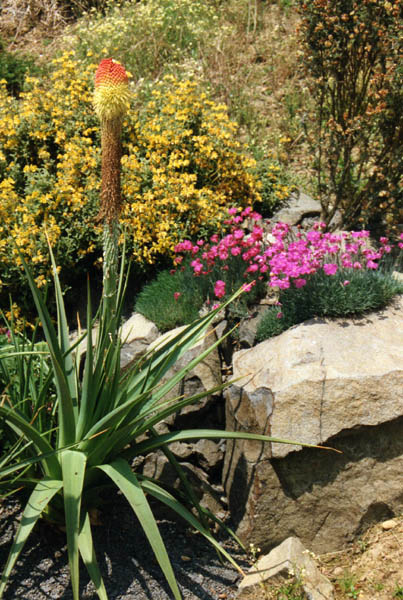
Robust perennial of the Asphodelaceae family, native to South Africa, where it grows in the mountainous areas of the Drakensberg and Lesotho, on moist slopes, by streams, and in high-altitude meadows, generally between 1,500 and 2,800 meters.
It is one of the most imposing species of the genus: it forms a massive and architectural rosette, reaching up to 1.50 m in diameter, with long, ribbon-like, bright green leaves, slightly keeled, arching downwards. The thick and robust flower stalks rise to 80–120 cm and bear a dense, cylindrical spike of tubular flowers, coral red in bud, gradually turning to cream yellow when opening, creating the characteristic bicolored gradient of the genus.
What immediately distinguishes K. northiae from other cultivated kniphofias is the exceptional size of its foliar rosette and the width of its leaves, significantly wider than most species of the genus, giving it an almost subtropical character.
In its natural habitat, its flowering extends from November to January (austral summer). In cultivation under our latitudes, it generally occurs in July-August.
It requires deep soil, fresh to moderately moist, well-drained in winter, in full sun. Its hardiness is limited to about -10°C; winter mulching usefully protects the heart of the rosette in cold climates. Placed at the foot of a rock garden, in deep soil, it fully plays its role as a signal plant, whose ample silhouette and luminous stalk contrast with the mineral of the stones and the cushions of surrounding rock garden plants.