Perennial of the Asteraceae family, native to the Caucasus and mountainous regions of Central Asia, where it grows on dry grasslands, rocky slopes, and high-altitude steppes, generally between 1,500 and 3,000 meters, on well-drained substrates.
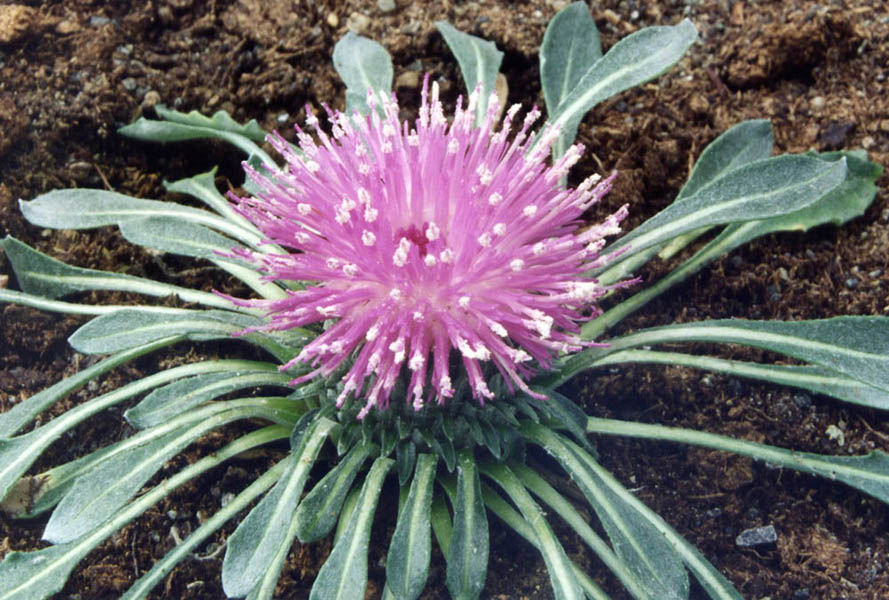
The plant is stemless, forming a low and spreading rosette, spectacular with its large oblong-spatulate leaves, grayish-green on the upper side and densely tomentose, almost white, on the underside. These leaves are entire or barely wavy on the margins, and their radiant arrangement gives the rosette a very distinct architectural habit, particularly striking at the time of flowering.
The capitulum, solitary, sessile or almost, develops directly at the center of the rosette, large and dense, composed of bright lilac-pink to purplish-pink tubular flowers, with very fine and elongated tubes that give it a woolly and radiant texture. The involucre is wide and solid, with appressed bracts.
What immediately distinguishes this species is its pronounced musky fragrance, noticeable from a distance — a rare quality in the genus, as its epithet moschus suggests. The roots were once used in oriental perfumery.
In its natural habitat, its flowering extends from June to August. In cultivation, it requires impeccable drainage, a poor mineral substrate, and full sun exposure; it tolerates summer drought well but fears persistent winter moisture.