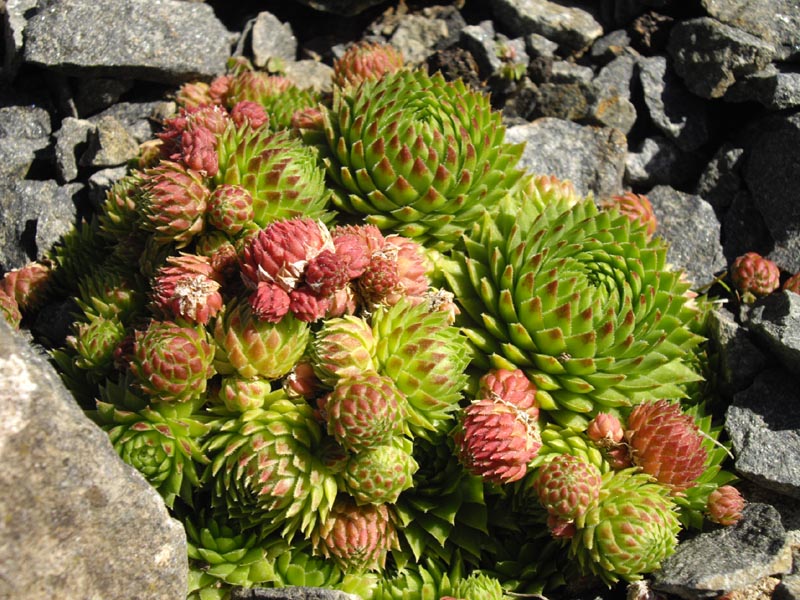
Succulent perennial of the Crassulaceae family, widespread from Central Europe to the Balkans and the Carpathians, where it colonizes rocks, stabilized sands, dry lawns, and sunny scree, on siliceous or mixed substrates, from the plains up to about 2,000 meters altitude.
Its rosettes, of medium size — 3 to 6 cm in diameter — are globular and well-closed, composed of fleshy, oval-lanceolate leaves, bright green to slightly tinged with reddish-brown at the tips, finely ciliated on the margins. This bright green, almost translucent on the young central leaves, is one of the freshest hues of the genus. The rosettes take on more coppery to reddish hues in full summer exposure.
Like J. allionii and J. arenaria, it multiplies abundantly by daughter rosettes that detach at the slightest touch and roll on the substrate to establish at a distance — the most pronounced and productive "roller" behavior of the genus, hence its epithet sobolifera, "bearing offspring".
In its natural habitat, its flowering extends from July to August; the flowers are bell-shaped, with delicately fringed pale yellow cream petals, gathered in a compact inflorescence at the top of a short stem.
It adapts to various substrates provided that the drainage is impeccable and the sunlight is total. Its vigor and ease of multiplication make it one of the most accessible jovibarbas for rock gardens, walls, and gravel gardens.