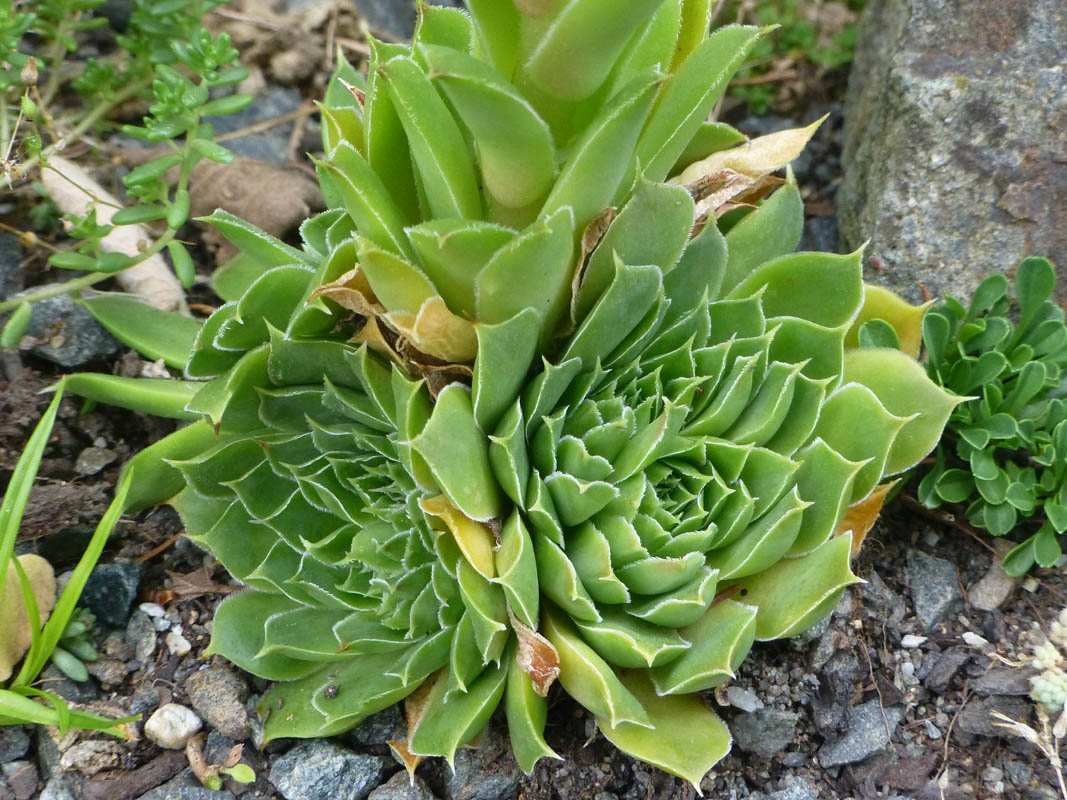
Succulent perennial from the Crassulaceae family, native to the Balkans and the Carpathians, where it grows on rocks, rocky outcrops, and sunny dry slopes, often on calcareous or mixed substrates, between 500 and 1,800 meters in altitude.
It is the most robust jovibarba of the genus: its rosettes, wide and flattened, can reach 8 to 12 cm in diameter, with thick, lanceolate leaves, with a mucronate tip, a bright green to slightly glaucous, finely ciliated on the margins and arranged in a tightly regular spiral of great geometric regularity. This ample and architectural habit clearly distinguishes it from other species of the genus.
It fundamentally differs from other jovibarbas by its mode of multiplication: it does not produce detachable daughter rosettes, but divides by fission, the mother rosette slowly subdividing from the center to form compact and persistent clumps.
The flowers, grouped in a dense and branched inflorescence carried on a stem of 15 to 20 cm, are bell-shaped, with fringed yellow-green to sulfur-yellow petals, with an unusually delicate appearance for such a robust plant. In its natural habitat, its flowering extends from June to July.
It tolerates varied substrates, including calcareous ones, provided the drainage is perfect and the exposure fully sunny. Hardy and durable, it is an excellent choice for rock gardens, walls, and container cultures.