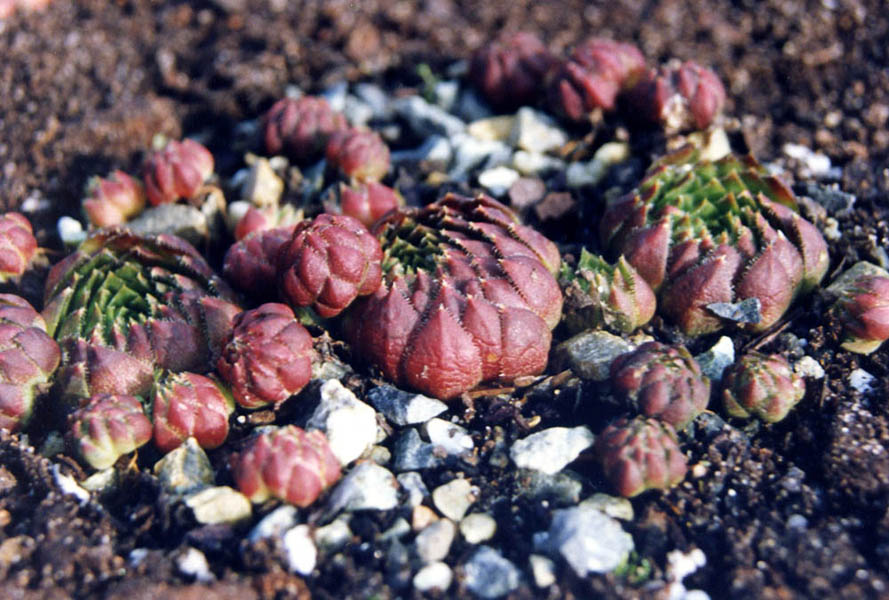
Succulent perennial of the Crassulaceae family, native to the Eastern Alps, mainly from Austria, Slovenia, and adjacent regions. It colonizes sands, siliceous gravels, open lawns, and acidic rocks at altitude, generally between 1,000 and 2,500 meters, in particularly poor and unstable environments.
It is one of the smallest jovibarbas of the genus: its rosettes, very small, rarely exceed 2 cm in diameter, and have short, fleshy, strongly convex leaves with a well-marked central vein, finely ciliated on the edges. Their hue is remarkable: a deep reddish-brown to purple, almost uniform, which contrasts with the subtle green reflections of the still young inner leaves.
Like all jovibarbas, it propagates by daughter rosettes that detach spontaneously — the famous "rollers" — quickly forming small dense and compact groups that spread over the mineral substrate. This mode of dissemination is particularly suited to sloping environments where the substrate moves.
In its natural habitat, its flowering extends from July to August, with small pale yellow bell-shaped flowers with fringed petals, characteristic of the genus.
It requires a siliceous, ultra-drained, poor substrate, in full sun. It is suitable for alpine troughs, acidophilic screes, and mineral compositions where the fineness of its purple rosettes can be observed up close.