Perennial of the Campanulaceae family, native to Western and Central Europe, from the Pyrenees to the Alps and the Massif Central, where it colonizes acidic grasslands, open moors, siliceous rocks, and sunny rocky slopes, generally between 800 and 2,000 meters in altitude.
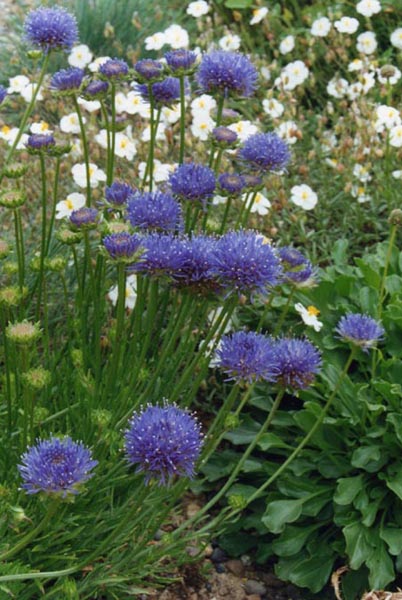
It forms a low, dense clump of linear, narrow, medium green leaves, slightly wavy at the edges, from which numerous slender and smooth stems rise, 20 to 40 cm tall, each bearing a solitary globular flower head. These small spherical heads, composed of tubular flowers with five very cut lobes, develop a bright and vivid blue-violet, punctuated by small protruding white styles that give each head a spiky and precious appearance.
It is precisely this texture of the flower — both dense and airy, between the scabious and the miniature thistle — that makes the species immediately recognizable and so appreciated in rock gardens. It is strictly calcifuge and only thrives on acidic substrates.
In its natural habitat, its flowering extends from June to August. In cultivation, it blooms generously from June to September if conditions are favorable.
It requires a siliceous, poor, well-drained soil, in full sun; it absolutely refuses limestone. Perfectly suited to acidic rock gardens, heather gardens, and compositions on reconstructed substrate, it reseeds modestly without becoming invasive.