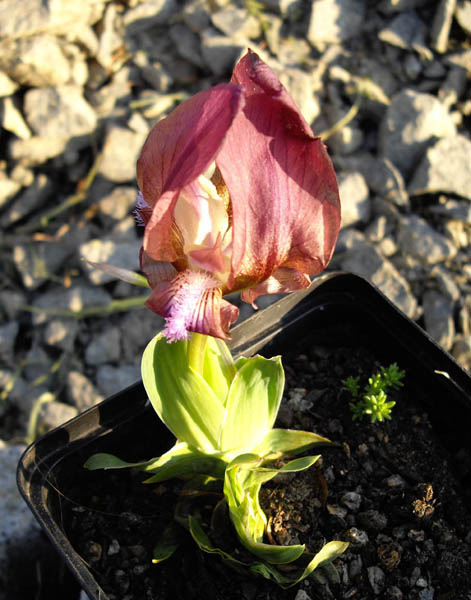
Iris suaveolens is a dwarf rhizomatous perennial of the Iridaceae family, native to the Balkans, Turkey, and the western Caucasus, where it grows on dry grasslands, limestone screes, and open rocky areas, often between 500 and 1,800 meters in altitude.
It forms small compact clumps barely exceeding 10 to 15 cm, with short, broad, and slightly curved leaves of a bright and shiny green in spring. The flower, relatively large compared to the plant's stature, seems to be borne directly by the leaf rosette as the stem is short.
The color of the flowers is one of the most distinctive features of the species: a blend of brown-pink, warm mauve, and golden tones, difficult to classify into a clear shade, varying among individuals from pink-brown to dull violet. The beard, in sharp contrast, is a vivid and well-supplied violet. The name suaveolens refers to a sweet fragrance that the flower is reputed to emit.
In its natural habitat, its flowering extends from April to May depending on the altitude. In cultivation, it generally blooms in March-April.
It requires perfect drainage, a calcareous or gravelly soil, and full sun exposure. It thrives in an elevated rock garden or container, sheltered from stagnant winter moisture which is fatal to it.