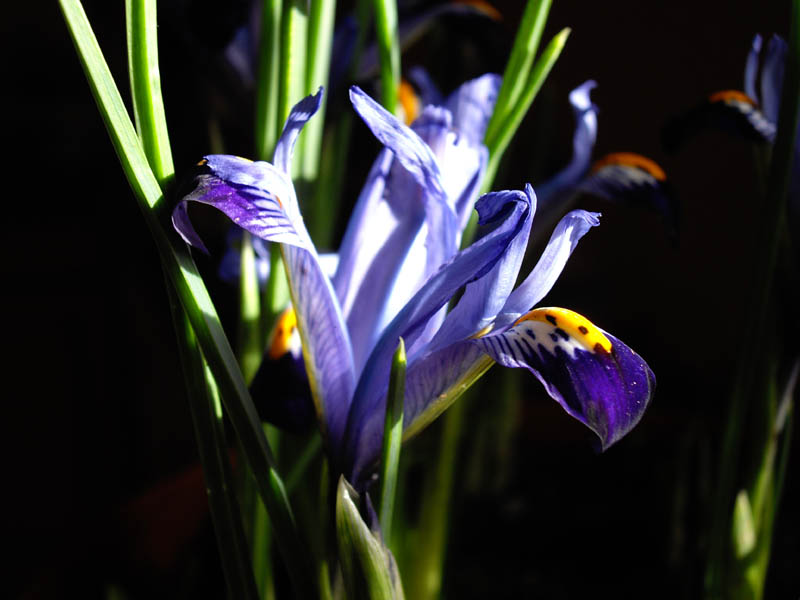
Iris reticulata 'Gordon' is a bulbous cultivar from the Iridaceae family, selected from the type species native to the Caucasus, Turkey, and Iran, where it grows on rocky slopes and dry high-altitude meadows, on well-drained substrates.
Like all reticulated irises, 'Gordon' does not exceed 10 to 15 cm at flowering. Its leaves are very fine, quadrangular in section, barely visible at the time of blooming and then elongating considerably after flowering.
This cultivar is distinguished by a particularly pronounced chromatic contrast: the standards are a very light lavender blue, almost periwinkle, while the falls, much darker, display a deep purple-violet enhanced by a bright orange-yellow crest on a fringed white background. This opposition between the pale standards and the intensity of the falls gives the flower a graphic and luminous character, very different from the unicolored forms of the species.
In its natural habitat, the flowering of Iris reticulata extends from March to April. In cultivation, 'Gordon' blooms in February-March, sometimes earlier in a well-sheltered position.
It requires a perfectly drained, light soil, in full sun, and appreciates a dry summer rest that allows the bulb to mature properly. Excellent performance in rock gardens, in pots, or between the stones of a wall.