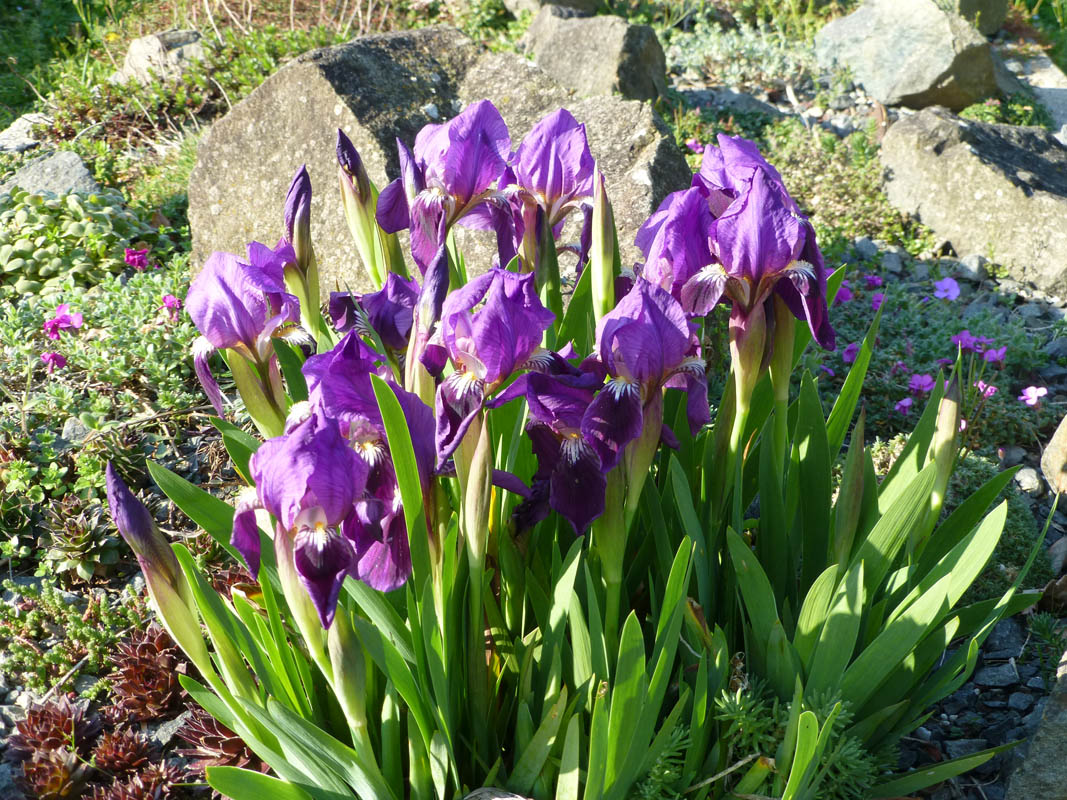
Iris pumila L., a rhizomatous perennial of the Iridaceae family, is native to the steppes and dry grasslands of Central and Eastern Europe, from the Pannonian plains to the Balkans and the Caucasus. It spontaneously colonizes rocky slopes, calcareous grasslands, and open garrigues, in full light.
It forms small, dense clumps with short, rigid foliage. Its flowers, borne on short stems, seem to emerge directly from the leaves — a stocky and compact habit that gives it a surprising presence for such a small plant.
This cultivar features flowers of an intense and bright purple-violet, almost uniform on both the falls and the standards, with a densely white beard slightly contrasting. The purple-violet is indeed the typical color of the species, the most widespread in the wild populations of the Pannonian steppes, although natural variations exist — from yellow to white and blue — depending on geographical origins.
In its natural habitat, the flowering of Iris pumila extends from April to May. In cultivation, this cultivar generally blooms in March-April, among the first perennials of the season.
Well-drained soil, poor to ordinary, absolute full sun: the growing conditions are the same as for the type species. It thrives between the stones of a rock garden or on a raised border, and above all fears stagnant moisture at the rhizome level.