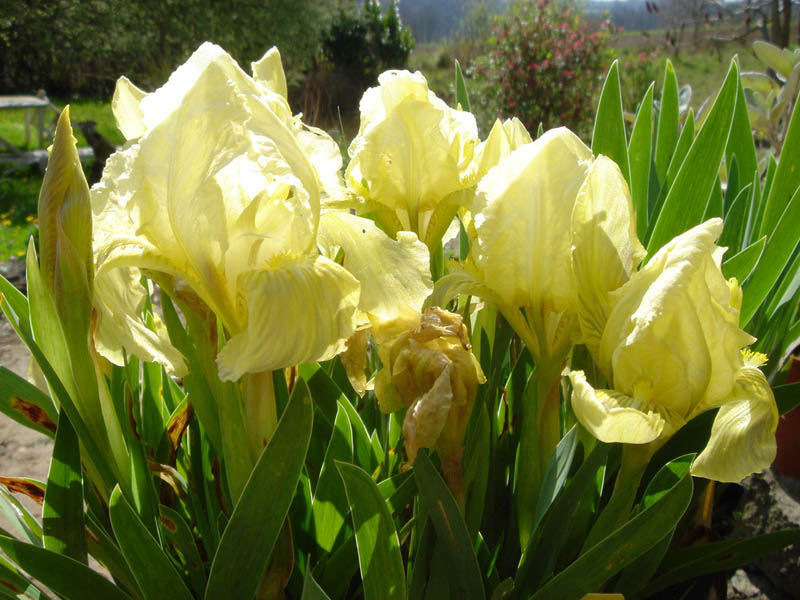
Iris pumila L., a rhizomatous perennial of the Iridaceae family, is native to Central and Eastern Europe, from the Pannonian steppes to the foothills of the Balkans and the Caucasus. It naturally grows in dry lawns, open garrigues, and sunny rockeries, on well-drained substrates, often calcareous.
It is one of the earliest dwarf irises in cultivation. It forms small, dense clumps of fan-shaped leaves, short and rigid. The flowering stem is so reduced that the flower seems almost placed directly on the foliage — a distinctive feature of the pumila group.
This cultivar bears flowers of a very pale yellow, almost sulfur cream, with a luminous softness particularly visible in the spring sun. The well-spread falls and erect standards are of the same hue, creating a flower with a round and homogeneous appearance, refined in its discretion.
In its natural habitat, the flowering of Iris pumila extends from April to May. In cultivation, this cultivar blooms from March-April depending on exposure.
It requires perfectly drained soil, poor to moderately fertile, in full sun. It dreads stagnant moisture at the collar, especially in winter. Ideal in rockeries, between stones or at the edge of a raised bed.