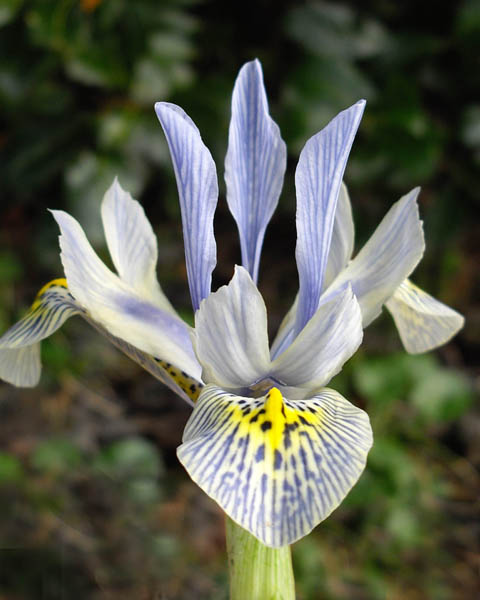
Iris histrioides 'Katharine Hodgkin' — Iridaceae. This cultivar is a hybrid between Iris histrioides, native to northern Turkey, and Iris winogradowii, a species from the Georgian Caucasus. It was obtained by E. B. Anderson and named in honor of Katharine Hodgkin, a British botanist and watercolorist.
A very small bulbous iris, it reaches 10 to 15 cm at flowering. The leaves, with the typical quadrangular section of reticulated irises, are barely out of the ground at anthesis.
The flower has a unique palette among irises of this season: the drooping sepals are cream to pale yellow, traversed by fine blue-violet veins and speckled with dark spots, with a bright yellow central ridge. The erect standards are lilac-blue streaked with white, creating a watercolor-like, almost translucent flower, unmistakable with any other cultivar.
In cultivation, flowering occurs in January-February, sometimes earlier depending on the climate. It is planted in autumn, in full sun, in very well-drained, stony or sandy soil, with a summer drought period respected to ensure proper bulb maturation. It readily naturalizes in rock gardens.