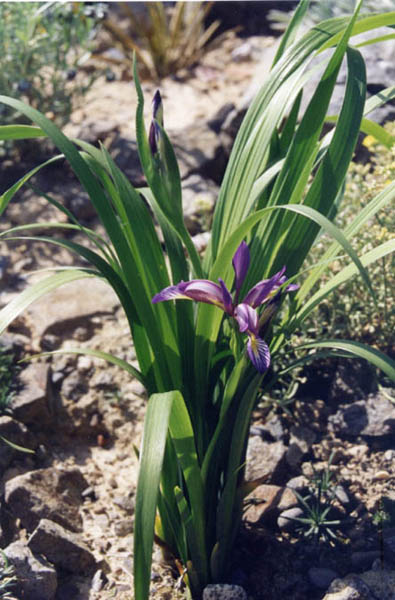
A rhizomatous perennial of the Iridaceae family, Iris graminea is widespread in southern Europe, from southern France to the Caucasus. It occupies meadows, forest edges, and open forests, generally at montane levels. In Switzerland, where it is considered vulnerable, it is confined to southern Ticino.
The clump is dense and vigorous, formed of linear leaves 50 to 70 cm long and 6 to 9 mm wide, with rough edges, well upright in sunny cultivation. The flower stem, 15 to 25 cm high, is entirely concealed by the foliage — a characteristic unique to this species among irises. The flowers, one to two per stem, feature outer tepals with an upper part white veined with violet and a lower violet part with a yellow median line; the inner tepals are an intense and pure violet, spatulate. The fruity fragrance, often compared to that of ripe plum, is one of the most distinctive traits of the species.
In its natural habitat, its flowering extends in May. In cultivation, it occurs at the same times.
In rock gardens, it is cultivated in full sun in well-drained, stony, moderately rich soil where it takes on a much more compact habit than that observed in shaded edges. It tolerates summer drought well once established and requires no special care.