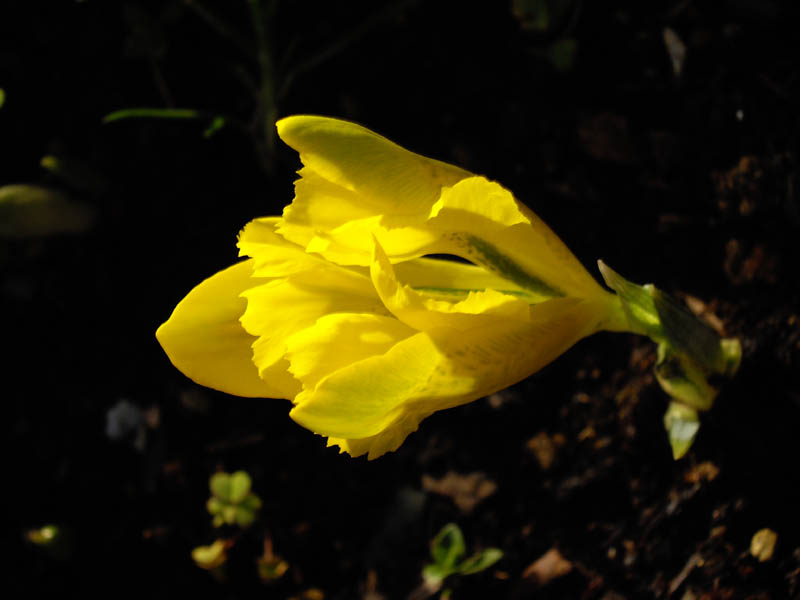
A perennial bulbous plant from the Iridaceae family, Iris danfordiae is native to central and southern Turkey, where it grows on rocky slopes and high-altitude limestone screes, generally between 1,500 and 2,500 meters. It belongs to the group of reticulated irises, characterized by their small bulbs with a reticulated-fibrous tunic and their winter or very early spring flowering.
It is one of the smallest bulbous irises in cultivation, barely exceeding 5 to 10 cm at flowering time, with very narrow quadrangular leaves that only fully appear after the flowers. The latter are of an intense and bright lemon-yellow, with external tepals finely crenellated at the edges and spotted with small dark olive-green dots in the center — a very distinctive detail easily visible to the eye. The standards, unusually reduced for an iris, are almost vestigial, giving the flower an open and singular aspect within the genus.
In its natural habitat, its flowering extends from February to March depending on altitude. In cultivation, it blooms from January-February, sometimes under the snow.
A noteworthy cultural behavior: after flowering, the mother bulb fragments into numerous small bulbils that take several years to reach flowering size, which explains the gradual decrease in flowers in subsequent years. A very well-drained, calcareous, warm, and dry soil in summer is essential.