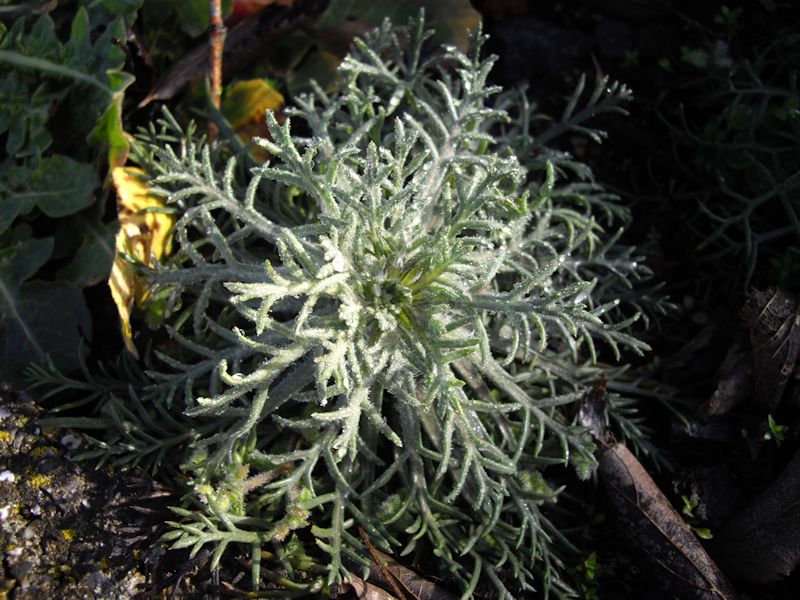
Biennial or short-lived perennial of the Polemoniaceae family, Ipomopsis aggregata is native to the western North America, the Rockies and the Great Plains, where it colonizes rocky slopes, dry high-altitude meadows and pine forest edges, generally between 1,500 and 3,000 meters. It is a mountain species well adapted to harsh winters and hot, dry summers.
During its first year — and this is what all these photographs show here — it forms a remarkably decorative basal rosette, flattened on the ground, consisting of finely cut leaves into narrow linear segments, densely covered with short hairs that give them a silvery gray-green appearance and a very particular velvety texture. The radiating arrangement of these compound leaves creates an almost geometric pattern, with an unexpected elegance for a plant in its vegetative phase.
In the second year, it raises a flowering stem that can reach 60 to 90 cm, bearing tubular flowers of a bright scarlet red to orange-red, highly sought after by hummingbirds in its natural habitat. In its natural environment, the flowering extends from June to August.
In cultivation, it requires a very well-drained, poor soil, in full sun, and does not tolerate winter humidity. It is sown and treated as a biennial rock garden plant.