A perennial of the Asteraceae family, Inula rhizocephala is native to Central Asia, from the high-altitude steppes and rocky areas of the Pamir, Tian Shan, and adjacent regions of Afghanistan and Pakistan. It grows on rocky and dry slopes, in conditions of intense winter cold and marked summer drought.
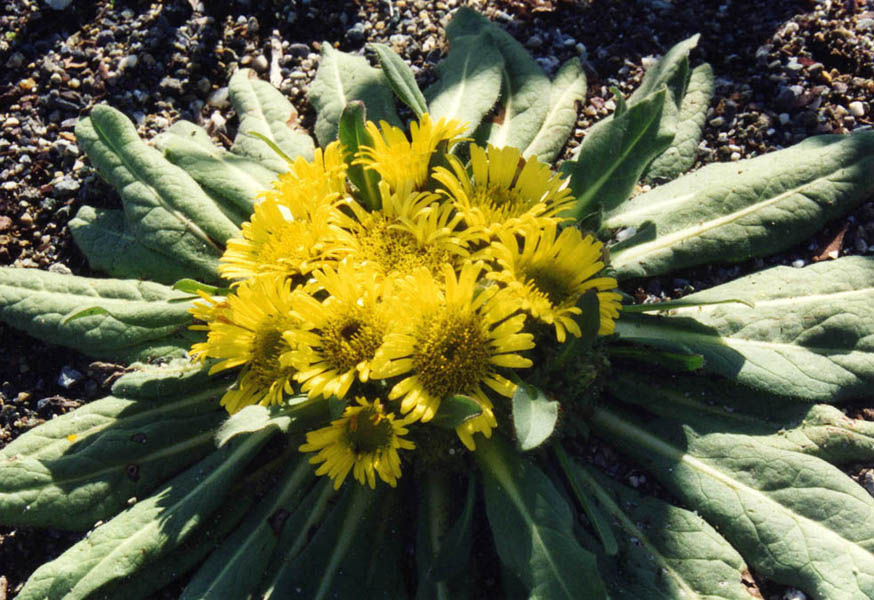
It is an acaulescent plant, completely devoid of visible stem: it forms a flat rosette, spread out at ground level, of large oval-elliptical leaves, thick, gray-green, with a bullate surface and finely tomentose, radiating from the center with an almost perfect geometry. This sprawling star-like habit is one of the most unique that can be observed in the genus.
The numerous and dense yellow flower heads emerge directly from the heart of the rosette without any apparent peduncle, placed like a compact bouquet on the foliage. The ligules are bright yellow, the involucral bracts reddish-brown, creating a very characteristic warm contrast. In its natural habitat, flowering extends from June to August. In cultivation, it generally occurs in June-July.
It requires a perfectly drained, poor, stony soil, in full sun, and does not tolerate stagnant winter moisture well. It is a collector's species, particularly suited to raised rock gardens and steppe gardens.