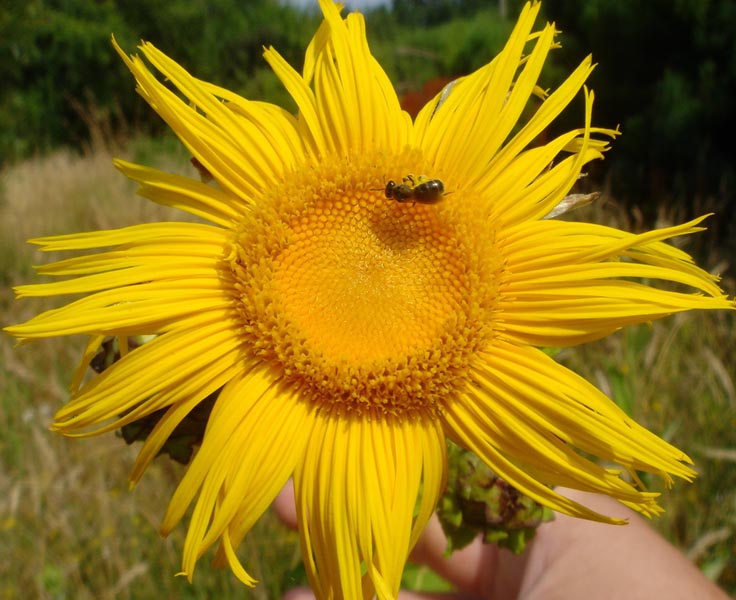
Perennial of the Asteraceae family, Inula magnifica is native to the Caucasus, where it grows in humid meadows, tall herb communities, and forest edges, in cool conditions well supplied with organic matter. Its epithet says it all: it is one of the most imposing of the genus.
It forms large bushy clumps that can reach 150 to 200 cm in height, supported by robust, upright stems. The leaves are very large, oval-lanceolate, rough to the touch, dark green, which gives the plant a distinctly architectural character from spring.
The flower heads are remarkably large, exceeding 15 cm in diameter: a central, deep yellow-orange dome, from which numerous narrow and long ligules radiate, of a bright luminous yellow, arranged loosely and slightly drooping, giving them a very characteristic tousled appearance. Each flower head is a rallying point for pollinating insects. In its natural habitat, flowering extends from July to August. In cultivation, it occurs at the same dates.
It thrives in full sun to partial shade, in deep, cool to moist soil, rich in humus. Hardy and vigorous, it is suitable for large naturalistic compositions, near water features, and prairie gardens.