Perennial of the Bignoniaceae family, Incarvillea delavayi originates from the high-altitude meadows and grassy slopes of Yunnan and Sichuan, in southwest China, between approximately 2,000 and 3,500 meters. It was introduced to Europe at the end of the 19th century by the French botanist and missionary Pierre-Jean-Marie Delavay, whose name it bears.
It develops a basal rosette of pinnate leaves, a bright and glossy green, deeply cut, borne by sturdy and erect stems that rise to 40–60 cm at the time of flowering. The plant emerges late in spring, which requires careful marking of its location to avoid damaging it.
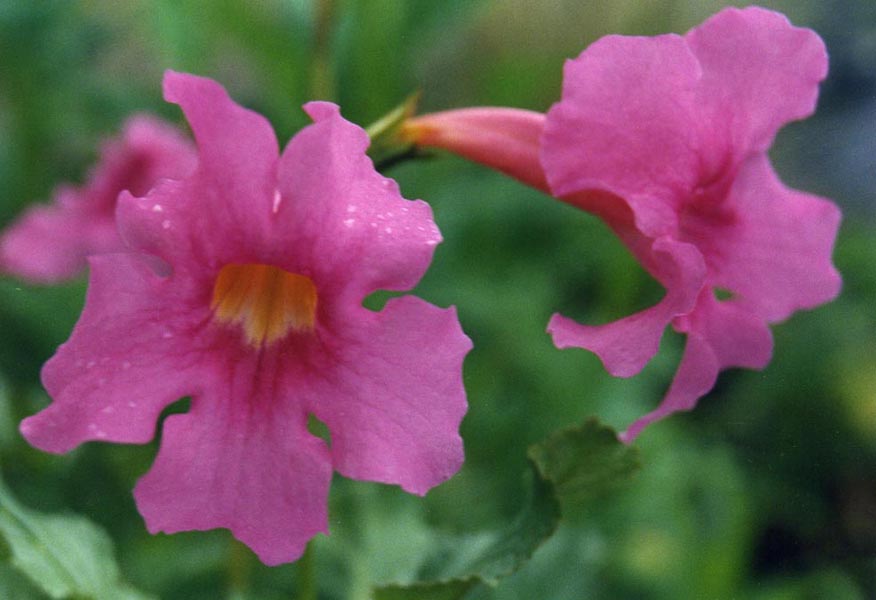
The flowers are large, tubular-flared, with five wavy lobes of a strong fuchsia pink, with a bright orange center that lights up the throat of the corolla — a warm and immediate contrast, very readable even from a distance. They are borne in loose clusters at the top of almost bare stems. In its natural habitat, its flowering extends from May to July. In cultivation, it generally blooms in May-June.
It requires a deep, well-drained soil, rich in humus, in full sun or very light partial shade. The collar, fleshy and fragile to frost, benefits from being protected in winter in cold regions. It adapts well to rock gardens in large basins or in raised flowerbeds.