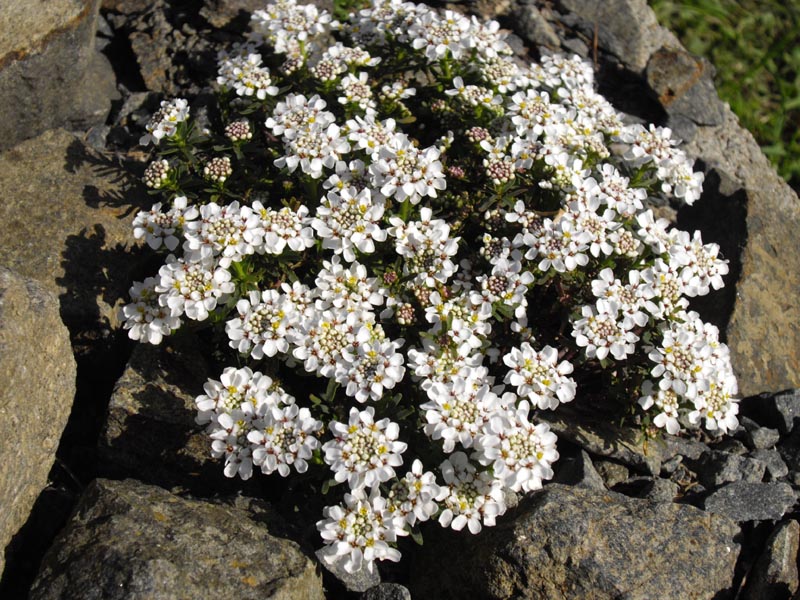
Perennial from the Brassicaceae family, Iberis sempervirens originates from the Mediterranean basin and the mountainous regions of southern Europe, from the Pyrenees to the Balkans. The 'Pygmaea' cultivar is a compact horticultural selection, obtained for rock gardens and small-scale gardens.
It forms a low, dense, and spreading cushion, woody at the base, barely exceeding 10 to 15 cm in height with a spread that can reach 30 to 40 cm. The foliage is evergreen, composed of small linear to spatulate leaves, dark green and glossy, which remain decorative throughout the year.
At the time of flowering, the foliage almost entirely disappears under a tight blanket of immaculate white corymbs, with the unequal petals characteristic of the Iberis genus, with a discreet yellow-green center. The buds, slightly pinkish before anthesis, add a delicate shade to the whole. In its natural habitat, the species' flowering extends from April to June depending on altitude. In cultivation, 'Pygmaea' blooms in April-May, sometimes as early as late March in well-exposed locations.
It thrives in full sun, in well-drained soil, preferably calcareous, without any particular richness requirement. Its naturally compact habit requires no special maintenance. Ideal on a wall, in a slab crack, or at the edge of a rock garden, it settles there permanently without overflowing.