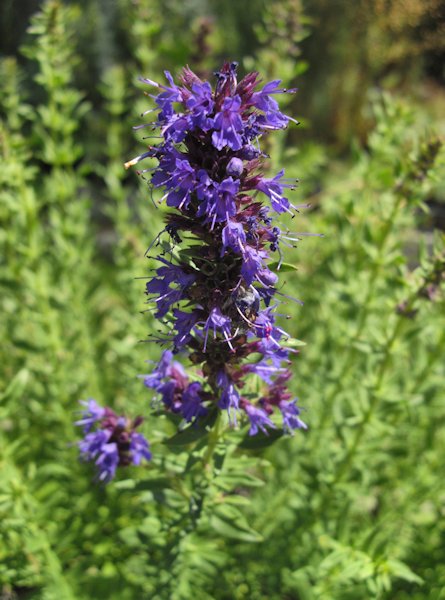
Perennial sub-shrub of the Lamiaceae family, native to the Mediterranean basin and Central Asia, naturalized in much of Southern Europe. It grows spontaneously on sunny limestone rocks, old walls, dry garrigues, and arid lawns, from sea level up to about 1,800 meters in southern mountainous areas.
The plant forms a dense, branched bush, 20 to 60 cm in height, with woody stems at the base and upright. The foliage consists of small linear to lanceolate leaves, dark green, persistent, strongly aromatic when crushed — a camphor-like and slightly bitter scent that has earned it a long history of medicinal and culinary uses. Hyssop is mentioned in ancient texts as a purification plant and remains used in traditional herbal medicine for its expectorant and digestive properties.
The flowers are tubular, bilabiate, an intense blue-violet, more rarely pink or white depending on the varieties, gathered in dense unilateral spikes and very honey-producing, frequently visited by bees and butterflies.
In its natural habitat, its flowering extends from July to September. In cultivation, it occurs at roughly the same dates.
It thrives in calcareous, poor, perfectly drained soil, in full sun, and tolerates summer drought well. It is slightly pruned after flowering to maintain a compact shape.