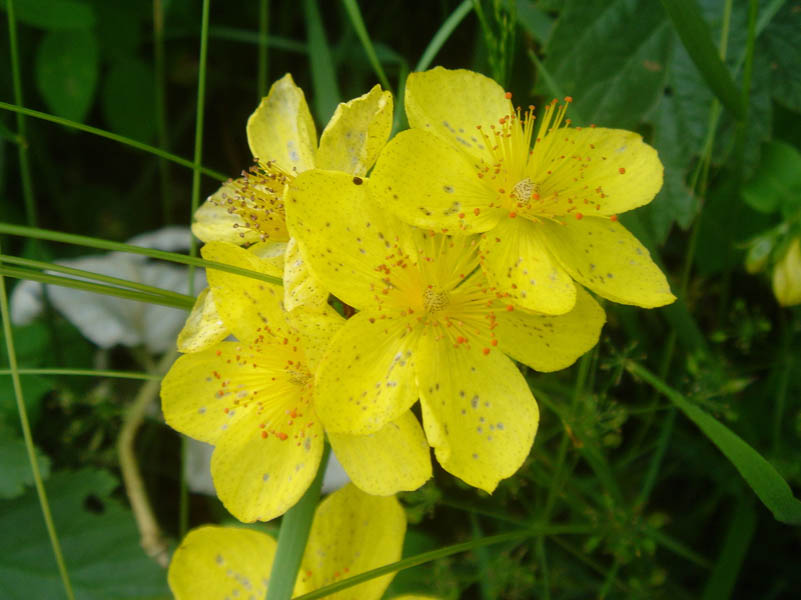
photographed in the Pyrenees
photographed in the Pyrenees
Perennial of the Hypericaceae family, this subspecies is endemic to the Pyrenees, where it occupies high-altitude grasslands, tall herb communities, roadsides, and subalpine meadows on calcareous or mixed substrates, generally between 1,200 and 2,400 meters. It differs from the more eastern and alpine type subspecies by its strictly Pyrenean range.
The plant forms erect, sparsely branched stems, 20 to 50 cm in height. The leaves are oval, sessile, of a medium green, traversed by translucent glands visible by transparency — a common feature of Hypericum — but especially marked by numerous black glands clearly visible to the naked eye, both on the blade and on the sepals, which is a reliable identification criterion for this subspecies.
The flowers are large, of a slightly pale bright yellow, with widely spread petals also bearing characteristic black dots, with a very visible cluster of stamens with orange anthers. They are grouped in sparsely furnished terminal cymes.
In its natural habitat, its flowering extends from July to August.
In cultivation, it appreciates a fresh, well-drained soil, in a sunny to semi-shaded exposure, and naturally integrates into cool rock gardens or gardens with a mountainous character.