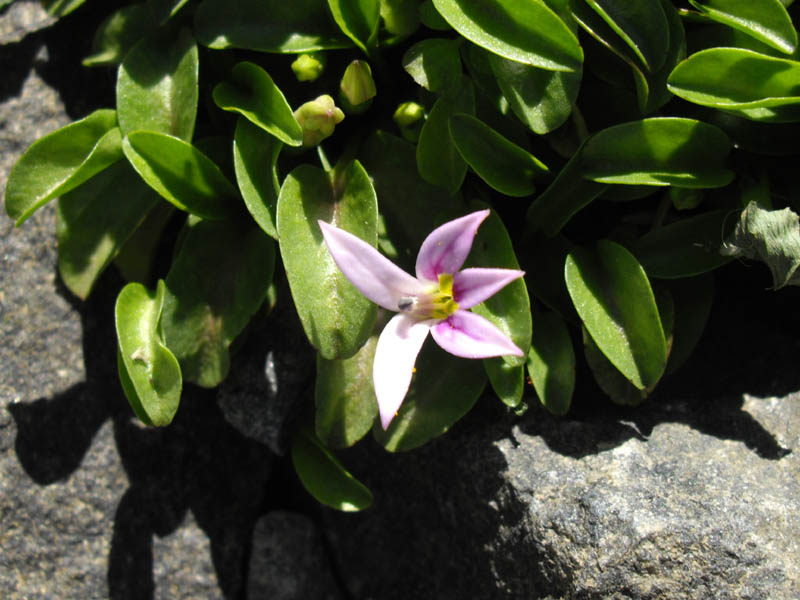
(Hypsela reniformis)
(Hypsela reniformis)
Creeping perennial of the Campanulaceae family, native to the Andes of South America, from Chile and Argentina, where it colonizes stream banks, rocky seepages, and high-altitude wet meadows. In cultivation, it has become a plant of choice for cool rock gardens, peat gardens, and the edges of water features.
It forms a very dense and regular creeping carpet, hardly exceeding 3 to 5 cm in height, consisting of small reniform to oval leaves, thick, fleshy, and shiny, dark green sometimes tinged with purplish hues on the underside. This compact and tight foliage gives the plant the appearance of a thick moss that covers the ground with remarkable regularity.
The flowers, solitary on short peduncles, are star-shaped, with five pale pink to lilac pink petals, marked with a bright yellow throat and pink-purple streaks that guide pollinators. Despite their small size, they emerge in sufficient numbers to sprinkle the foliage carpet with a multitude of colorful dots.
In its natural habitat, its flowering extends from November to February in the southern hemisphere. In cultivation under our latitudes, it blooms from May to July.
It requires soil that is constantly cool to moist, rich in humus, in semi-shaded to shaded exposure. It does not tolerate drought or active limestone and is sensitive to harsh winters in waterlogged soil.