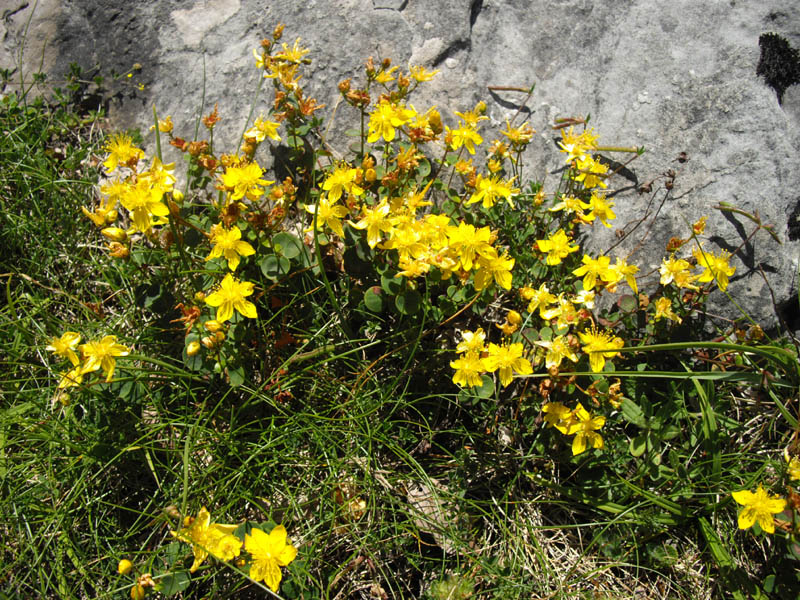
photographed in the Pyrenees
photographed in the Pyrenees
Dwarf sub-shrub of the Hypericaceae family, endemic to the Pyrenees, with some known stations in the western Alps, notably in Isère. It frequents limestone walls and rocks, crevices of cliffs and fixed screes, from 500 to 2,500 meters altitude. In its natural habitat, it almost systematically slips into the crevices and fissures of the rock, or nests at the foot of a block, taking advantage of the coolness and moisture retained by the stone, often in the shade or partial shade of exposed walls. It is this characteristic rupicolous behavior that makes it so discreet despite the brilliance of its flowers.
The plant forms small loose tufts with slender and arched stems, rarely beyond 20 to 30 cm. The foliage is composed of small oval-rounded leaves, dark green, reminiscent in shape of the nummular — which the species name faithfully translates. The flowers, bright and luminous yellow, with five petals and long radiating stamens, bloom in small terminal clusters.
In its natural habitat, its flowering extends from July to August depending on the altitude.
In cultivation, it requires a limestone soil, very well-drained, in a partially shaded exposure; it thrives in rock gardens or tucked between stones that keep its roots cool.