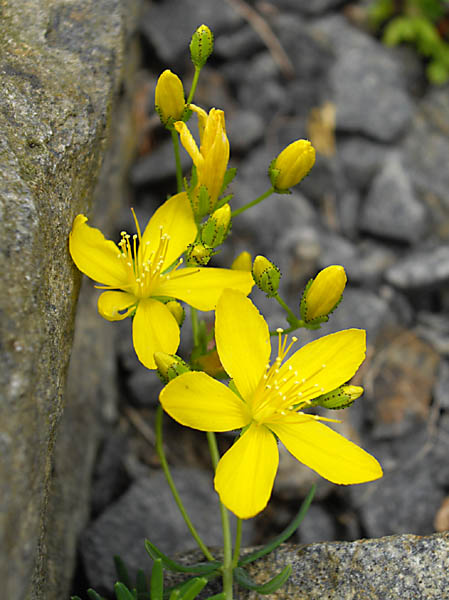
Dwarf evergreen sub-shrub of the Hypericaceae family, native to the northwestern Mediterranean region: southern France, northern Italy, southern Switzerland, and the western Balkan Peninsula. It is confined to sunny calcareous rocks, stabilized screes, and dry alpine lawns, generally between 500 and 1,800 meters, sometimes higher in the Maritime Alps.
The plant forms small woody clumps at the base, upright to slightly spreading, 10 to 25 cm in height. Its foliage is one of its most distinctive features: the leaves are very narrow, linear, whorled in threes or fours, of a glaucous green, resembling more a Coris or a heather than the usual silhouette of St. John's worts. The stems are slender, and the flower buds, reddish to orange, contrast beautifully before opening.
The flowers are bright yellow, with well-spaced petals and numerous stamens, gathered in elongated and loose clusters. In its natural habitat, flowering extends from June to August depending on altitude; in cultivation, it generally occurs from May to July.
It requires a calcareous, very well-drained, poor soil, in full sun. It withstands summer drought and resists frost down to about -12°C in dry soil, making it a reliable species for well-exposed alpine rock gardens.