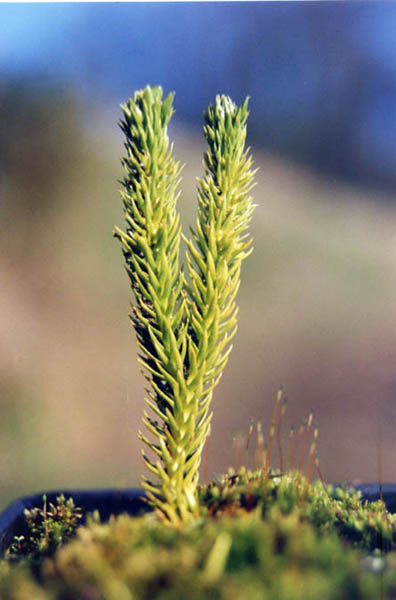
(Lycopodium selago)
(Lycopodium selago)
Vascular plant without flowers from the family Huperziaceae (formerly classified among the Lycopodiaceae), Huperzia selago is a circumboreal and mountainous clubmoss, present in Europe, Asia, and North America. It colonizes boggy heaths, mossy rocks, moist siliceous screes, and acidic alpine meadows, from low altitudes to over 3,000 meters in the Alps and the Pyrenees.
The plant forms clumps of 5 to 20 cm, upright in young individuals, more spread out and bushy in well-established subjects in the wild. The stems branch by repeated dichotomy, giving the whole a dense and structured appearance. They are entirely covered with linear microphylls, rigid, dark green to yellowish-green on young shoots, arranged in a tight spiral along their entire length. The overall texture evokes more a compact moss than a vascular plant, contributing to its unique character.
Huperzia selago produces neither flowers nor distinct cones: it reproduces by reniform sporangia borne in the axils of the leaves, as well as by small vegetative propagules, the bulbils, visible at the top of the stems at maturity, a characteristic detail that distinguishes it from other clubmosses.
A very slow-growing plant, it is protected in several European countries. In cultivation, it requires an acidic substrate, constantly moist, rich in sphagnum or leaf humus, in shade or partial shade, without limestone. It is more suited to specialized collections than ordinary gardens, and it testifies to a plant lineage several hundred million years old.