Perennial of the Rubiaceae family, Houstonia caerulea is native to the eastern part of North America, where it grows in moist meadows, clearings, roadsides, and slightly acidic forest edges, from Canada to the Appalachians. The 'Millard's Variety' selection is a particularly compact and floriferous horticultural form, highly appreciated in European rock gardens.
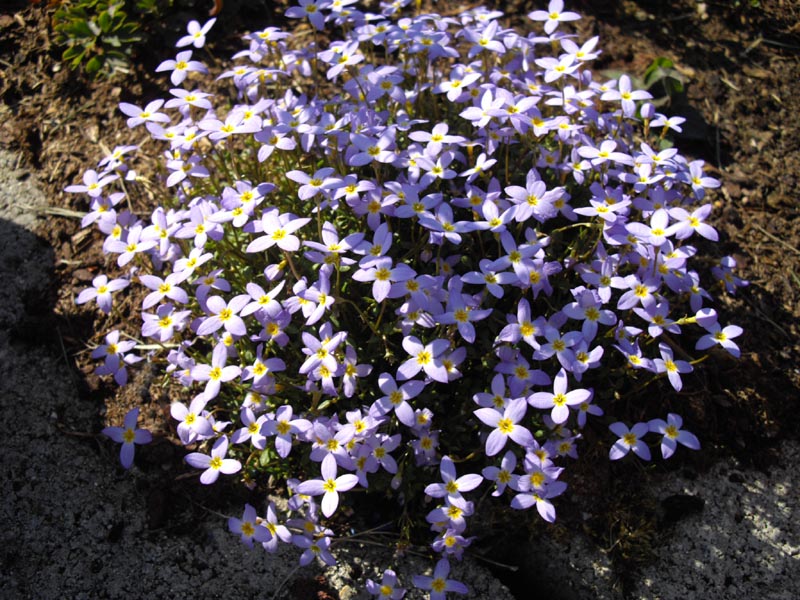
The plant forms a dense, rounded cushion, 5 to 10 cm in height, composed of very small, dark green, glossy oval leaves, which almost entirely disappear under the flowers at the time of blooming.
The flowers, borne individually on thin, thread-like peduncles, have four star-spread petals, in a soft blue-lilac to pale lavender, enhanced by a bright yellow central eye. This contrast between the delicate blue of the petals and the golden yellow spot is one of the most immediate charms of this plant. The flowering is remarkably dense, covering the cushion with an almost continuous colored veil.
In its natural habitat, the species blooms from April to June. In cultivation, 'Millard's Variety' blooms from March to May, with sometimes a slight resurgence in autumn.
It prefers a fresh, humus-rich, slightly acidic, and well-drained soil, in a sunny to semi-shaded exposure. It does not tolerate drought or calcareous soils. A place in a cool rock garden or light bog garden suits it perfectly.