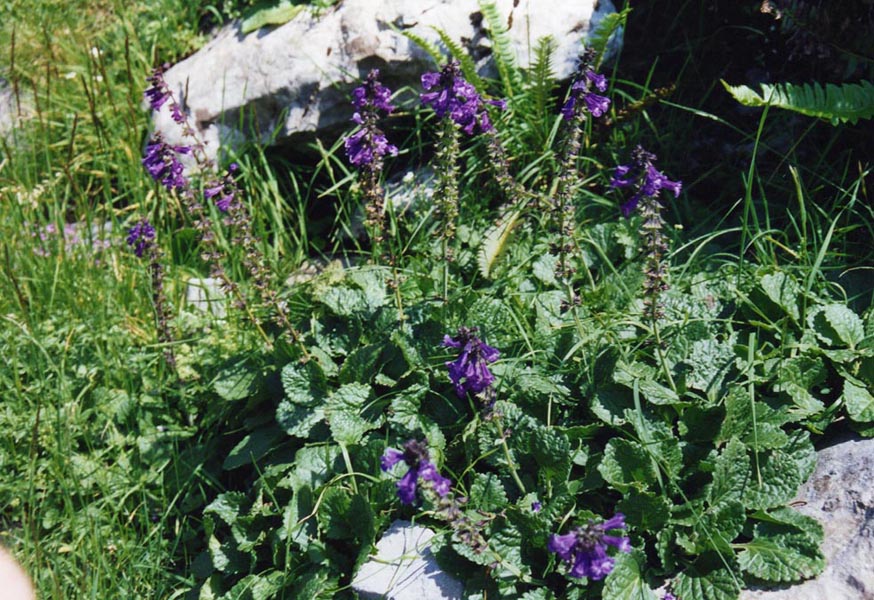
photographed in the Pyrenees
photographed in the Pyrenees
Perennial of the Lamiaceae family, Horminum pyrenaicum is a species endemic to the mountainous regions of southern Europe, found in the Pyrenees, the western and central Alps, as well as in the northern Apennines. It grows in alpine meadows, grassy rockeries, stabilized scree, and fresh meadows, generally between 1,400 and 2,500 meters in altitude, on both limestone and silica.
The plant forms a dense and persistent basal rosette of oval-cordate, crenate leaves, dark green and distinctly bullate in texture, reminiscent in appearance of certain melissas. From this rosette rise slender, erect floral stems 20 to 40 cm tall, bearing small, sessile, decreasing leaves.
The tubular, bilabiate flowers, of an intense purple-violet to deep blue-violet, are arranged in spaced whorls along the stems, with dark colored bracts that enhance the visual effect of the spike. This sustained violet hue, rare at this altitude among the Lamiaceae, is one of the most striking features of the species.
In its natural habitat, its flowering extends from June to August depending on exposure and altitude. In cultivation, it generally blooms in June-July.
It appreciates well-drained soil, fresh without excess, in sunny to semi-shaded exposure. The only representative of its genus, it deserves a place of choice in alpine rockeries and mountain gardens.