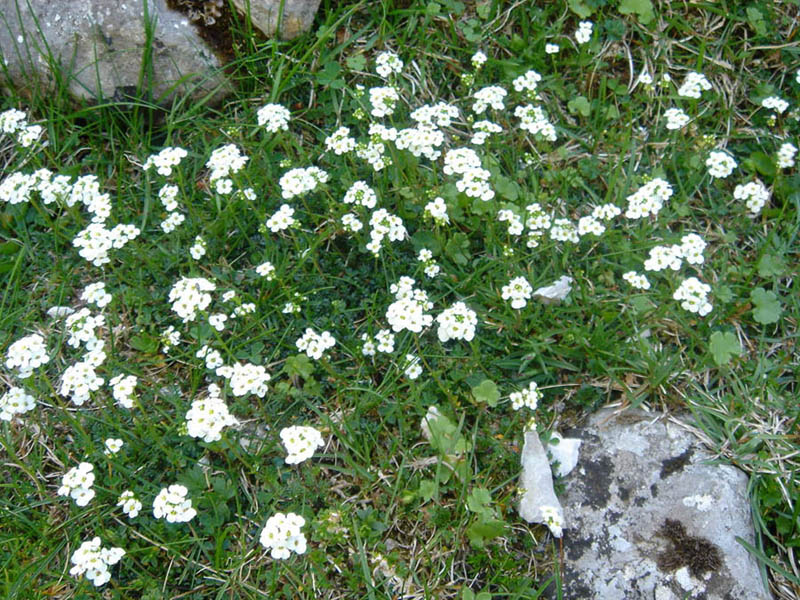
photographed in the Picos de Europa
photographed in the Picos de Europa
A perennial of the Brassicaceae family, Hornungia alpina is a species of the mountains of Central and Southern Europe, found in the Pyrenees, the Alps, the Apennines, and the Carpathians. It occupies stabilized limestone screes, rock crevices, moraines, and high-altitude gravel, generally between 1,500 and 3,000 meters, in well-exposed and excellently drained locations.
The plant forms small, dense, and spreading tufts, distinctly prostrate, only 5 to 15 cm in height. The foliage consists of small pinnatisect leaves, a fresh and shiny green, forming a compact and finely cut carpet, pleasing even when not in bloom.
The flowers are tiny, with four rounded white petals, grouped in tight corymbs that literally cover the plant at flowering time, giving it the appearance of a white cloud resting on the stones. Up close, each small flower reveals a slightly greenish heart.
In its natural habitat, its flowering extends from June to August depending on altitude. In cultivation, it blooms from May-June, sometimes with a resurgence in autumn.
It requires a very well-drained, stony, poor soil, in full light, and poorly tolerates any persistent moisture at the collar. Ideal between the stones of a rock garden or in the crevices of a wall, it is one of the neatest and most reliable ground covers of alpine gardens.