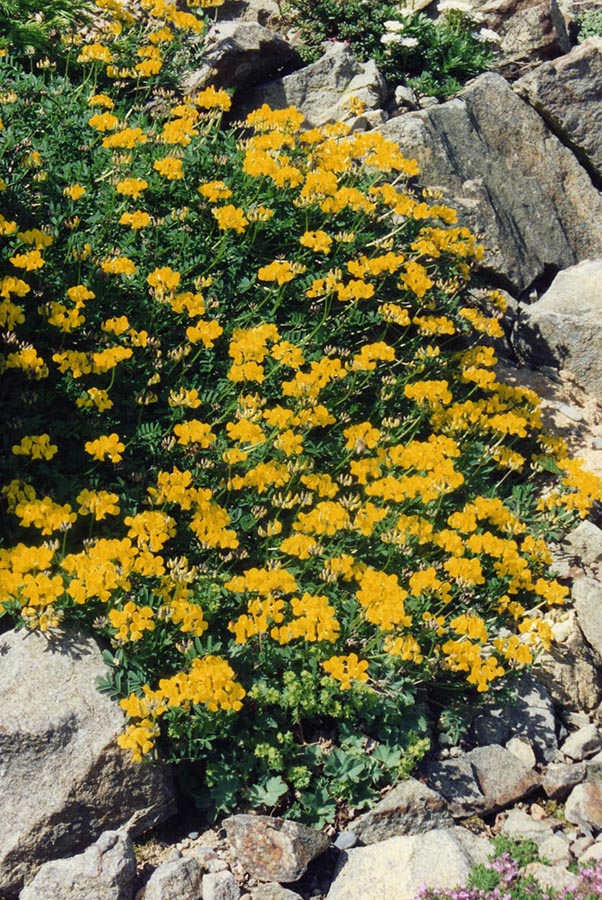
A perennial from the Fabaceae family, Hippocrepis comosa is widespread across much of central and southern Europe, from the British Isles to the Balkans, including the Alps, the Pyrenees, and the Mediterranean region. It colonizes dry and rocky grasslands, calcareous screes, ledges, and cracks in rocks exposed to the sun, generally between 500 and 2,000 meters in altitude.
The plant forms spreading, semi-prostrate clumps, 10 to 30 cm in height, with a loosely bushy habit. The foliage consists of small pinnate leaves, medium green to grey-green, which discreetly cover the branching stems.
The papilionaceous flowers, in a bright yellow to luminous orange-yellow, are grouped in umbels of five to twelve flowers borne by short peduncles. Their standard is streaked with fine orange veins, visible up close. The pod, characteristic of the genus, has lateral constrictions shaped like horseshoes, which gives the plant its generic name.
In its natural habitat, its flowering extends from May to July depending on altitude. In cultivation, it generally blooms from May to June.
It requires a calcareous, well-drained to dry soil, in full exposure. Perfectly suited to rockeries and walls, it does not tolerate stagnant moisture or heavy soils.