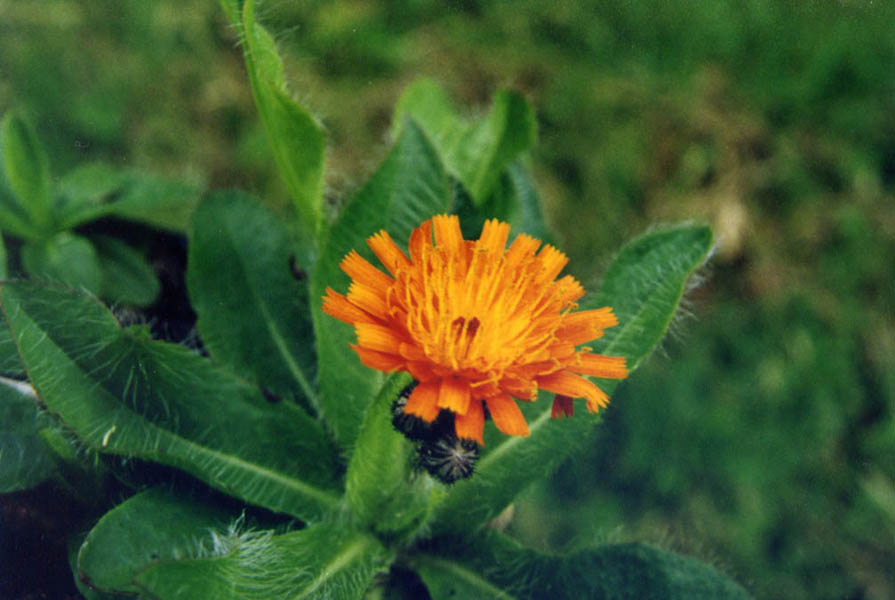
Perennial of the Asteraceae family, Hieracium aurantiacum is native to the mountains of Central and Southern Europe, from the Alps to the Carpathians and the Sudetes. In its natural habitat, it colonizes high-altitude meadows, poor grasslands, edges, and rocky slopes, generally between 1,000 and 2,500 meters, on poor and well-drained substrates.
It forms small basal rosettes, from which arise erect, slender, and hairy flowering stems, 20 to 40 cm in height, bearing a few reduced leaves. The plant spreads by stolons and can form dense mats over time. The basal leaves are lanceolate to oblong, medium green, covered with stiff hairs that give them a slightly rough texture to the touch.
The capitula, grouped in terminal corymbs of 5 to 15 heads, are bright orange to burning reddish-orange, a very rare color in the Hieracium genus, earning the plant its common name of orange hawkweed. This fiery hue, almost tropical in an alpine context, is its most immediately striking characteristic.
In its natural habitat, its flowering extends from June to August. In cultivation, flowering occurs from May to July. It tolerates poor, dry to fresh, well-drained soils, in full sun; hardy and undemanding, it can however become invasive through its stolons in open spaces.